
Choosing a Civil Contractor in Coimbatore: A Practical Guide
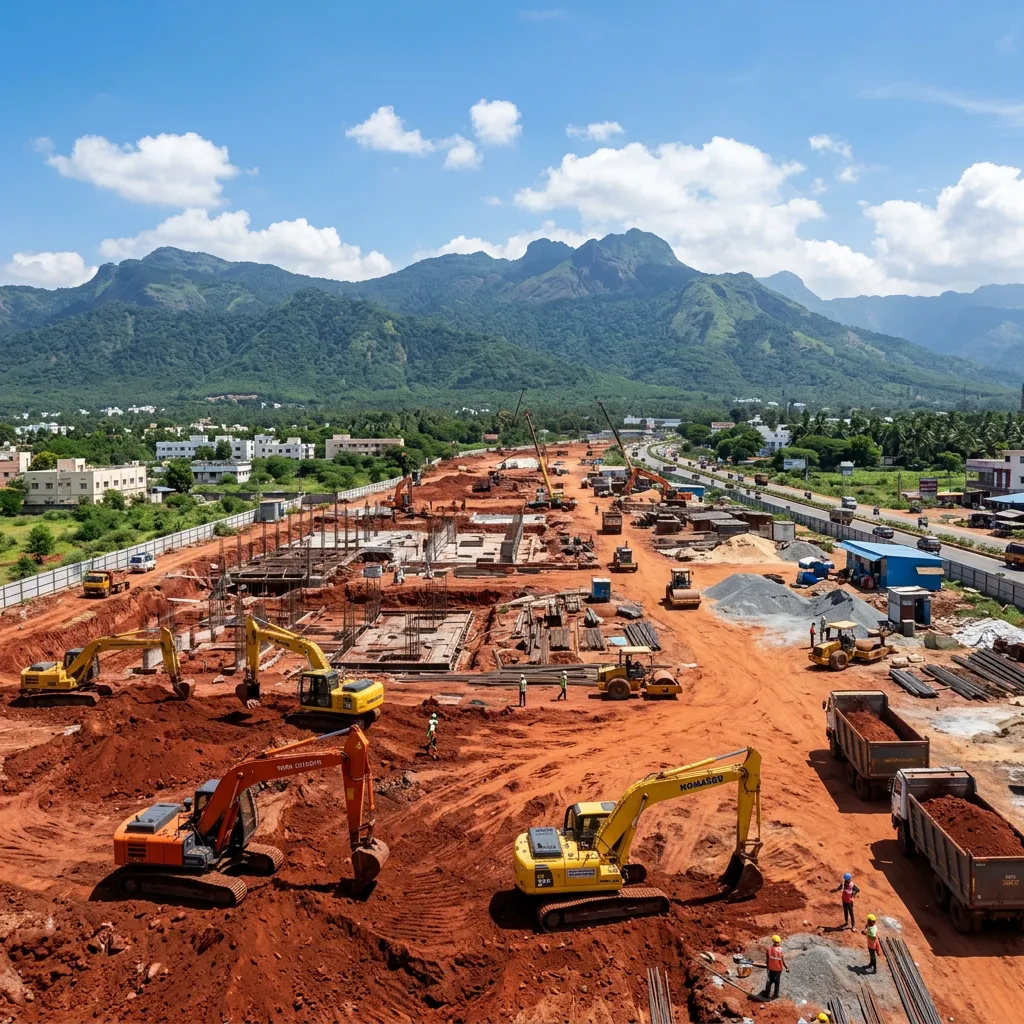
The safest way to choose a civil contractor in Coimbatore is to verify three documents before anything else: the PWD Class-I licence number, the current GST registration, and the company's CIN if it is incorporated. Everything else — quotes, fleet photos, testimonials — is negotiable detail, but a contractor who cannot produce these three on request should not be shortlisted. This guide walks through what we tell prospective clients ourselves, because the same checks that protect a client from a fly-by-night operator are the checks that let a genuine site development or foundation contractor win the job on merit rather than on the lowest headline number.
1 · Verifying PWD/NHAI Licensing and GST/CIN Before You Sign
A Tamil Nadu PWD Class-I civil contractor licence is issued against a specific registration number, for us TN/PWD/CBE/CIV/01/2019, and it is renewable and revocable — meaning a contractor's status can change year to year. Before you sign a work order, ask for the licence number in writing and cross-check it rather than accepting a scanned certificate at face value, since certificates get reused for years after they lapse. A First Class NHAI registration (ours is RC/2021/0871) is a separate credential from PWD Class-I and matters specifically if your project touches a national highway package or an NHAI-funded structure; a contractor holding only a municipal licence cannot legally bid an NH package as prime contractor. GST registration and, where the firm is incorporated, a Corporate Identification Number (CIN) confirm the entity you are contracting with actually exists as a taxable, liable business rather than an individual operating under a trade name with no balance sheet behind it.
We also recommend asking how long the firm has held its current licence class, since PWD licensing is tiered and contractors are promoted from Class-II to Class-I based on demonstrated project value and turnover over successive years. A firm freshly promoted to Class-I may be entirely competent, but a firm that has held Class-I standing since 2019 or earlier, as we have, has a longer public track record you can verify against completed PWD and NHAI project registers. ISO 9001:2015 (quality management) and ISO 45001:2018 (occupational health and safety) certifications are a further, voluntary layer — they are not mandatory for PWD bidding but indicate the contractor runs documented quality and safety systems rather than ad hoc site practices, which matters most on projects with concrete cube testing, compaction records, or multi-agency handover requirements.
2 · Reading a Contractor's Owned-Fleet List vs Rented Equipment
Ask any shortlisted contractor for a written breakdown of which machines on their proposal are owned outright and which are hired for the duration of your project. A firm running a mixed fleet of excavators, motor graders, soil compactors, backhoe loaders and tippers that it owns — we operate roughly 85 machines across these categories — can mobilise on a fixed internal schedule because it is not competing with other rental customers for the same grader during peak season. Rented-fleet contractors are not automatically unreliable, but their delivery dates are only as firm as the rental yard's availability, and that dependency rarely shows up in a quote until a machine fails to arrive.
Fleet ownership also affects how a contractor prices unexpected scope. If a soil compactor breaks down mid-project and the contractor owns a second unit, downtime is measured in hours; if the machine is rented and the yard has nothing spare, downtime can run days and the delay risk sits with your schedule, not theirs. When you inspect a contractor's fleet list, ask specifically about compaction equipment, excavation equipment, and haulage capacity, since these three categories drive the pace of nearly every civil works phase from excavation through grading to final compaction testing.
"A contractor who cannot produce a licence number, a GST registration, and a CIN on request should not be shortlisted — everything else is negotiable detail."
3 · What a Fixed Line-Item Quote Should (and Shouldn't) Include
A serviceable civil works quote itemises earthwork volumes in cubic metres, aggregate and cement quantities by grade, labour classes (skilled/unskilled/supervisory), and machinery hours separately from materials — a single lump-sum figure with no breakdown gives you nothing to audit against later measurement sheets. Ask specifically whether the quote is inclusive of GST and labour cess, since Tamil Nadu construction contracts attract both and a quote that omits them will read cheaper on paper and more expensive at final billing. It should also state assumptions explicitly: soil type assumed for excavation rates, water table depth if dewatering is priced in, and whether monsoon-season productivity derating has been built into the schedule.
What a quote should not include is a single blended day-rate covering machinery, labour and materials together, because that structure makes it impossible to verify whether you were charged fairly for a change in scope later. We price our own quotes as itemised schedules precisely so a client's engineer can check quantities against a measurement sheet at each billing milestone, the same discipline PWD and NHAI billing cycles already require of us on public contracts.
4 · Site Visit Red Flags: Questions to Ask Before Mobilisation
Before mobilisation, insist on a physical site visit rather than a remote quote based on satellite imagery or a plot plan alone — soil conditions, access road width for tippers, and existing drainage direction all change the scope in ways a desk estimate misses. During the visit, ask who the site-in-charge will be by name, what their reporting cadence is (daily WhatsApp updates, weekly written reports, or neither), and whether a soil test or borelog will be commissioned before excavation begins or whether the contractor is proposing to excavate first and adjust later. A contractor unwilling to commit a named site engineer, or vague about who supervises day to day, is a genuine red flag regardless of how competitive their price looks.
Also ask what happens if unexpected groundwater, rock, or contaminated fill is encountered mid-excavation — a competent contractor will have a standard variation-order process ready to describe, not a blank look. Coimbatore's geology varies from red loam to rocky fringe within a few kilometres, so a firm quote that never mentions soil variability as a possible cost driver is either inexperienced with the district or deliberately underquoting to win the job and renegotiate later.
5 · Payment Milestones and Measurement Sheets: Protecting Your Budget
Structure payments against verified physical milestones, not calendar dates: mobilisation, completion of excavation to design level, subgrade compaction sign-off, and so on, with each milestone tied to a joint measurement sheet signed by both your representative and the contractor's site engineer before funds release. This is the same discipline PWD departmental engineers apply on public works billing, and it is worth insisting on for private work too, since it prevents disputes over "how much was actually done" months after the fact. Avoid large upfront payments beyond a reasonable mobilisation advance; a contractor with genuine owned-fleet capacity does not need 50% of contract value in hand before moving a single machine onto site.
Keep a copy of every measurement sheet, material test certificate, and site diary entry yourself rather than relying solely on the contractor's records — if a dispute arises later, independently held documentation is what protects you. If your project involves any government approval or future resale, ask the contractor to hand over as-built drawings and compaction test reports at final handover as a matter of course, not as a special request; it should already be standard practice for any firm operating under ISO 9001:2015 quality documentation, as we do on every project.
Operational Summary & Takeaways
Choosing a civil contractor in Coimbatore comes down to verifiable documentation, an honestly itemised quote, and a payment structure tied to physical measurement rather than trust alone. Sri Vari Constructions holds PWD Class-I licence TN/PWD/CBE/CIV/01/2019 and First Class NHAI registration RC/2021/0871, operates an owned fleet of roughly 85 machines, and serves Coimbatore, Tiruppur, Erode, Salem, Pollachi, Karur, Namakkal, Dindigul, the Nilgiris, Mettupalayam, Sulur and Udumalpet. If you are evaluating contractors for an upcoming project, our team is available to walk through a site visit and an itemised quote — reach out through our contact page to schedule one.