
Panchayat Link Road Contractors in the Kongu Region
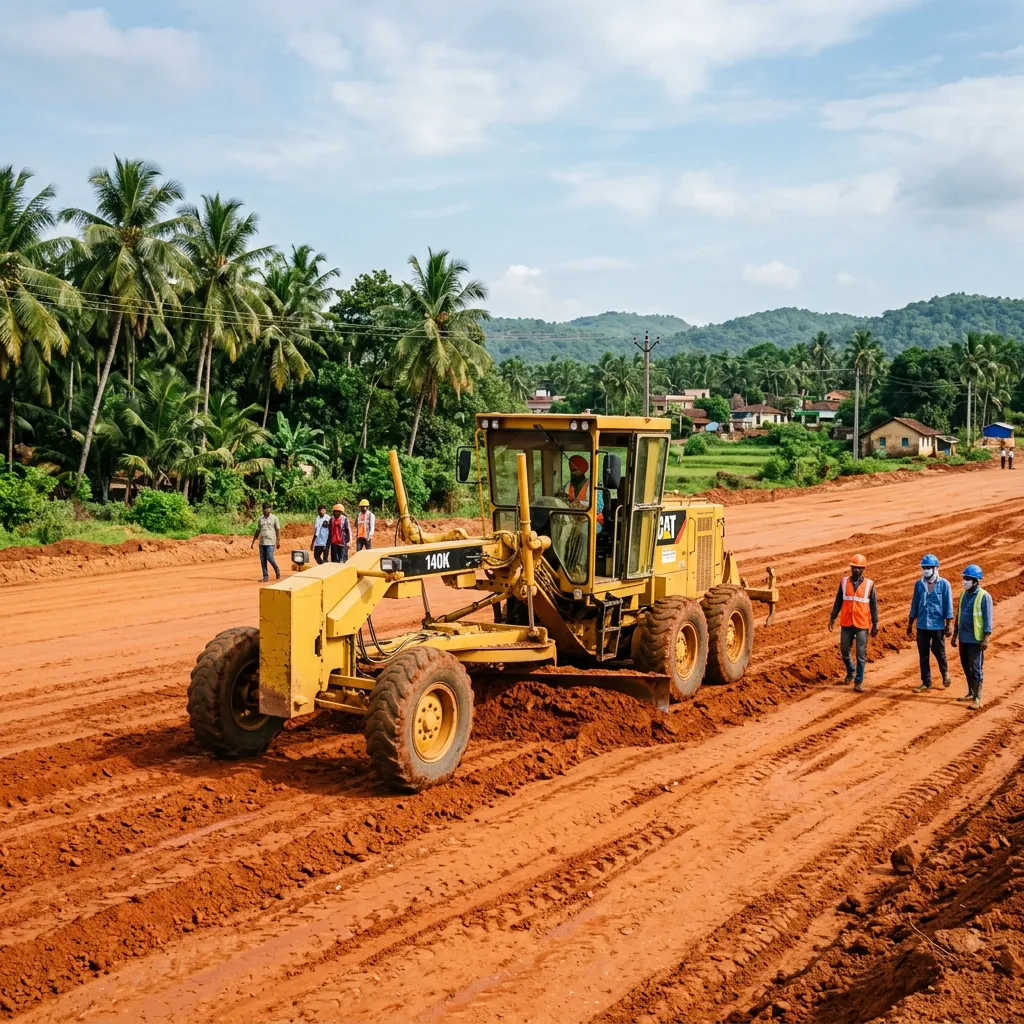
Panchayat link road contractors in the Kongu region work under a tendering and design framework that is deliberately lighter than PWD state highway packages: smaller contract values, single-lane carriageway widths as narrow as 3.75 metres, and construction manuals built specifically for low-traffic rural roads rather than state highways. Sri Vari Constructions has executed link road works for panchayats and rural development agencies across the Coimbatore, Tiruppur and Erode belt, and the technical discipline required — minimal-width geometric design, tight material-cost control, and construction sequencing around agricultural traffic — is different enough from state PWD or NHAI work that it deserves its own playbook. This piece covers how we plan, price and deliver panchayat-scale link roads in the Kongu region, from tender structure through to handover documentation.
1 · How Panchayat Link Road Tenders Differ from PWD State Packages
Panchayat link road works in Tamil Nadu are typically sanctioned and administered through the Rural Development and Panchayat Raj framework rather than the PWD Highways wing directly — tenders are floated by the panchayat union or district rural development agency, with technical sanction and measurement overseen by an Assistant Executive Engineer attached to the rural development structure rather than a PWD divisional office. The estimated contract value on a typical panchayat link road package sits well below a state highway resurfacing or NHAI stretch, which changes who competes for the tender: firms without Class-I standing regularly bid these packages, though our Class-I registration lets us take them on alongside larger road construction work without any separate qualification hurdle.
The technical manual referenced also differs. Rural link roads are designed to IRC:SP:20, the Rural Roads Manual, rather than the IRC:37 and MoRTH Specifications for Road and Bridge Works framework that governs state highway crust design. IRC:SP:20 and its companion IRC:SP:72 for low-volume roads assume traffic in the T1-T2 category — under roughly 1 million standard axles over the design life — which permits thinner, lower-cost pavement crusts than a state or national highway would ever be approved for. Getting this classification right at the design stage is what keeps a panchayat link road affordable without under-building it for the traffic it will actually carry, which is a different balancing act from the one we run when pricing a rural road package under a state-funded scheme.
2 · Minimal-Width Carriageway Design for Village Access Roads
IRC:SP:20 permits a single-lane carriageway as narrow as 3.75 metres with 1.25-metre gravel shoulders on either side for roads carrying under roughly 100 vehicles a day, which describes most panchayat link roads connecting a village to the nearest through-route. Where traffic is a little heavier — a road serving multiple hamlets or a market junction — we move up to an intermediate-lane width of 5.5 metres. Right-of-way on these roads is typically 10-12 metres, though in built-up village stretches it often compresses to 7.5 metres between existing compound walls, and design speed drops to 30-50 km/h with correspondingly relaxed sight-distance and curvature standards compared to a state highway.
Pavement crust on a minimal-width village road is sized against the subgrade CBR obtained from IS 2720 Part 16 testing rather than assumed, since Kongu belt soils range from stable red loam to poorly draining black cotton pockets within a few kilometres. Subgrade testing at 5-6% CBR typically supports a crust of granular sub-base plus two WBM courses finished with a thin premix carpet surface — adequate for T1 traffic but nowhere near what a state highway crust under IRC:37 would specify. Getting the crust thickness matched to actual subgrade strength, rather than over-building on a fixed template, is what keeps panchayat-scale projects within their sanctioned estimate.
"Getting the crust thickness matched to actual subgrade strength, rather than over-building on a fixed template, is what keeps panchayat-scale projects within their sanctioned estimate."
3 · Local Material Sourcing to Control Panchayat-Scale Budgets
Panchayat and rural development schedule-of-rates figures run lower than PWD state SOR, which means haul distance to the nearest usable quarry or gravel source has an outsized effect on whether a link road project stays within its sanctioned estimate. We work to a defined sourcing radius for moorum, blue metal and WBM-grade aggregate on these projects, and in the Kongu belt that discipline is the same one we apply when sourcing aggregate across Coimbatore district for larger packages — it just has less budget slack to absorb a longer haul.
Shoulders on minimal-width roads are typically left as compacted gravel or moorum rather than paved, both because IRC:SP:20 permits it for low-traffic roads and because it removes a materials line item that a panchayat-scale budget cannot easily carry. Where masonry cross-drainage or retaining structures are needed, we source locally quarried stone rather than manufactured block wherever the specification allows, and we run WBM courses using aggregate crushed within the sourcing radius rather than importing higher-grade material that the traffic category doesn't actually require. Matching material grade to the design traffic category, rather than defaulting to a higher spec than necessary, is where a meaningful share of panchayat-scale cost control happens.
4 · Working Around Agricultural Traffic and Harvest Seasons
A single-lane village link road cannot simply be closed for the duration of construction the way a divided highway carriageway can be worked in isolation — the same road is usually the only route local tractor-trailers, milk collection vehicles and bus services use. We sequence work in half-width stages wherever the carriageway width allows it, keeping one side passable with a flagman-controlled diversion, and where full-width closure is unavoidable for culvert or base-course work, we coordinate the closure window directly with the panchayat president and local transport operators rather than simply posting a notice.
Harvest season adds a second constraint: sugarcane crushing season through January-March and other local harvest peaks bring heavy, overloaded tractor-trailer traffic onto exactly the roads we're resurfacing. A freshly laid premix carpet surface needs a minimum curing window before it can safely take that axle loading, so we time final surfacing courses to avoid opening a green surface directly into peak harvest traffic wherever the programme allows, and where it can't be avoided, we hold heavy traffic off the new surface with temporary diversions until the bitumen has properly set.
5 · Handover to the Panchayat: Documentation and Defect Liability
Completion on a panchayat link road is certified jointly — our site engineer and the panchayat union's Assistant Executive Engineer or Junior Engineer sign a joint measurement book recording final quantities against the sanctioned estimate, and a completion certificate is issued before the security deposit and final bill are released. As-built details, particularly culvert and cross-drainage locations, are handed over as part of this record since the panchayat, not a PWD division, becomes responsible for future maintenance once the defect liability period closes.
The defect liability period on Tamil Nadu rural road works is typically twelve months from completion, during which any settlement, surface raveling or drainage defect attributable to construction quality is rectified by the contractor at no additional cost, backed by a retained security deposit. We treat this the same way we treat DLP obligations on our larger PWD and NHAI contracts — as a real commitment rather than a formality — since a panchayat with a limited maintenance budget has far less capacity to absorb early pavement failure than a state highway division does, and our reputation across the Kongu belt depends on that road still performing well after the retention money is released.
Operational Summary & Takeaways
Panchayat link road work in the Kongu region rewards a contractor who treats it as its own discipline rather than a smaller version of a state highway job — different tendering authority, a design manual built for low-traffic roads, tighter material-cost control, and construction sequencing that has to coexist with harvest-season farm traffic rather than override it. Sri Vari Constructions holds PWD Class-I licence TN/PWD/CBE/CIV/01/2019 and First Class NHAI registration RC/2021/0871, and takes on panchayat and rural-scheme link road packages alongside larger state and national highway contracts across Coimbatore, Tiruppur, Erode, Salem, Pollachi, Karur, Namakkal, Dindigul, the Nilgiris, Mettupalayam, Sulur and Udumalpet. If your panchayat or union has a link road package coming up for tender, reach out through our contact page to discuss scope and timeline.