
Quarry & Aggregate Sourcing for Road Projects in Coimbatore District
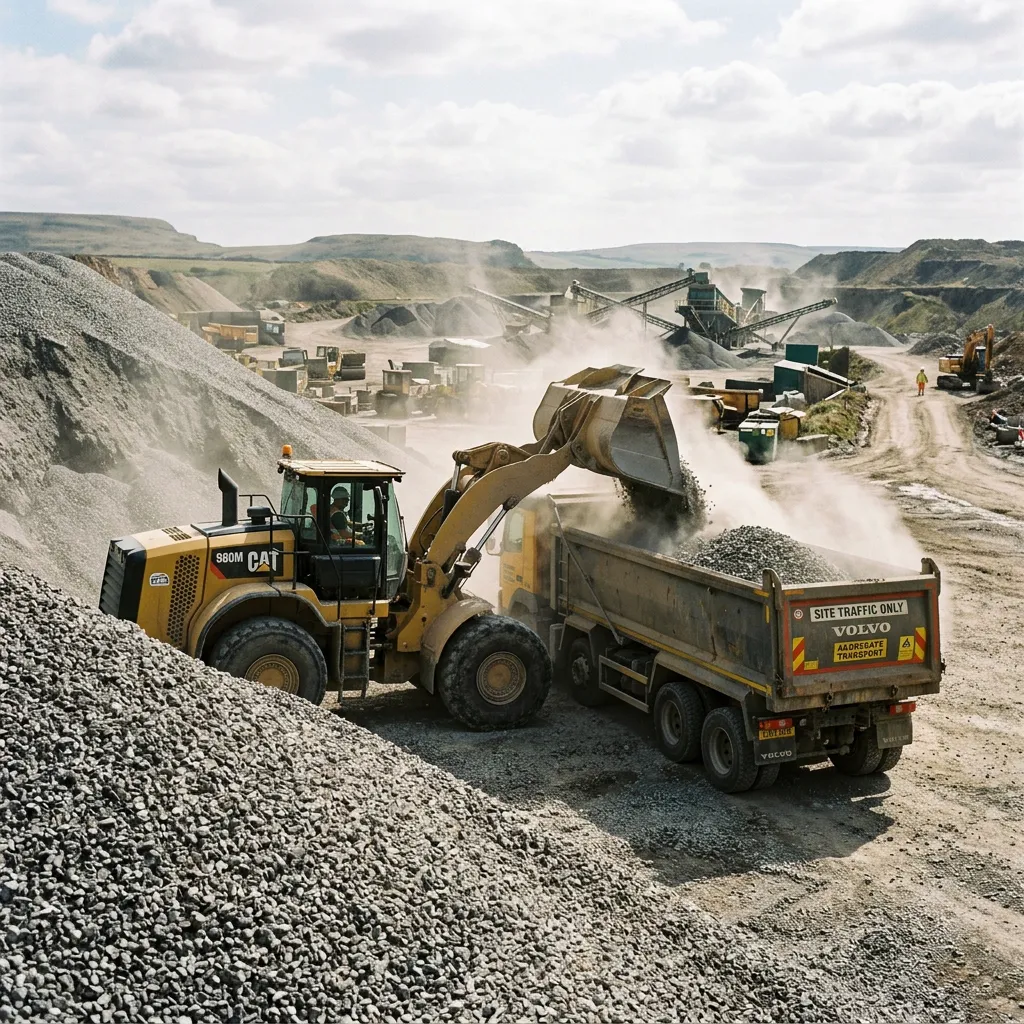
Quarry and aggregate sourcing for road projects in Coimbatore district comes down to three things once a supplier relationship already exists: verified gradation and crushing value testing, dispatch logistics that keep a paving train fed without gaps, and documentation that survives a PWD or NHAI material receipt inspection. This is distinct from choosing which quarry to use in the first place; it's about what we do at the material-quality and logistics level once sourcing decisions are made. Here's how we audit, dispatch, and document aggregate for road work across the district.
1 · Quarry Auditing: Aggregate Gradation and Crushing Value Testing (IS 383)
Before a quarry is added to our approved supplier list for a live road package, we run sieve analysis on sample loads to confirm gradation falls within the envelope specified for the pavement layer it's destined for, whether that's GSB, WMM, or a bituminous course, since a single quarry's output often varies enough between blasting faces that one batch passing gradation doesn't guarantee the next one will. IS 383 governs the grading limits and physical requirements we test against, and we treat a supplier's own test certificates as a starting reference rather than a substitute for our own periodic sampling.
Aggregate crushing value and impact value testing tell us whether a source's stone will hold up under compaction and traffic loading rather than degrading into fines during the construction process itself. We run crushing value tests per IS 2386 methodology on new sources and re-test periodically on existing ones, since a quarry can shift extraction to a different rock face partway through a contract without necessarily flagging the change, and a shift from hard trap rock to a softer, more weathered stratum shows up as a crushing value that no longer meets our threshold for base course or wearing course material.
2 · Seasonal Quarry Relationships and Priority Dispatch Agreements
Aggregate demand across the district spikes sharply once monsoon clears and the paving season opens, and quarries with limited crushing capacity end up rationing dispatch across multiple contractors competing for the same output. We maintain standing relationships with a set of quarries across the district specifically so that priority dispatch is agreed before the seasonal rush starts, not negotiated under pressure once a paving train is already idle waiting on material.
These agreements typically commit us to a minimum offtake volume across the season in exchange for guaranteed daily dispatch slots during peak demand periods, which gives the quarry planning certainty and gives us supply certainty in return. We track each quarry's actual crushing output against our forecast requirement through the season and adjust standing orders where a source is running below capacity, rather than discovering a shortfall only when a truck fails to arrive on a scheduled dispatch morning.
"A quarry can shift extraction to a different rock face partway through a contract without necessarily flagging the change."
3 · Logistics: Fleet Dispatch Optimisation to Control Haul Costs
Haul distance from quarry to site is one of the largest variable costs in any aggregate-heavy road contract, so our dispatch planning weighs each approved source's distance against its gradation and testing profile rather than defaulting to whichever quarry is cheapest per tonne at the gate. A source that's marginally more expensive but ten kilometres closer to an active paving front often works out cheaper landed, once tipper cycle time and fuel are factored in, than the nominally lower-priced option further away.
We coordinate dispatch using GPS-tracked tippers and a central logistics schedule that sequences loading slots against the paving crew's actual consumption rate, so trucks arrive in a steady rhythm rather than bunching up and creating queuing delays at the tipping point, or falling behind and stalling the paver. Cycle time data collected across a contract also feeds back into future quarry selection, since a source with excellent material quality but consistently poor loading turnaround at the quarry gate can still cost a project more in machinery idle time than a marginally lower-grade source with faster dispatch.
4 · Blue Metal vs M-Sand Sourcing for Different Pavement Layers
Blue metal, crushed hard rock aggregate, is the primary material for granular sub-base, WMM, and bituminous layers, and we source it in graded sizes specific to each layer's requirement rather than accepting a single all-purpose grading from a quarry and screening it further on-site, which is both slower and less consistent than getting correctly graded material at the source. For a road package running through several pavement courses, we typically hold separate standing orders with different quarries or different crushing lines at the same quarry to match each layer's grading envelope precisely.
Manufactured sand, produced by crushing and grading stone rather than dredging riverbed material, has become our default fine-aggregate source for concrete and mortar work given the tightening restrictions and inconsistent availability of natural river sand across the district. M-sand requires its own gradation and silt-content checks distinct from blue metal testing, since an overly fine or poorly graded batch affects workability and strength in ways that coarse aggregate testing won't catch, so we run separate sieve analysis specifically for fine aggregate on every new M-sand source before approving it for structural use.
5 · Quality Documentation for PWD/NHAI Material Receipt Inspections
Every aggregate delivery on a PWD or NHAI package needs a paper trail that survives inspection by the departmental or Authority Engineer: delivery challans tied to specific quarry sources, our own gradation and crushing value test results, and where required, third-party laboratory verification for critical layers. We maintain a material receipt register that logs each delivery against its source quarry, test result, and the specific chainage or structure it was used in, so that if a quality question arises on a completed stretch, we can trace the material back to a documented, tested batch rather than relying on memory or informal records.
This documentation discipline matters most at billing stage, since departmental engineers routinely cross-check material test registers against work executed before certifying a running account bill for payment, a process we cover in more detail in our note on handling NHAI billing cycles without stress. Keeping quarry-level testing and dispatch records current through the contract, rather than reconstructing them retroactively at billing time, is what keeps that certification process moving without the delays that incomplete material records commonly cause.
Operational Summary & Takeaways
Quarry and aggregate sourcing for road projects across Coimbatore district is as much a quality-control and logistics discipline as it is a procurement exercise, and getting gradation testing, dispatch scheduling, and documentation right at the sourcing stage prevents problems that are far more expensive to fix once material is already laid. This piece builds on our broader notes on sourcing the best gravel in Coimbatore district and negotiating terms with local suppliers, which cover selection and commercial terms rather than testing and logistics. As a licensed PWD Class-I and First Class NHAI road contractor active across Coimbatore, Tiruppur, Erode, and Salem, we apply this same sourcing discipline to every road construction package we take on — contact us to discuss material sourcing for your project.