
Dewatering Services for Construction Sites in Coimbatore
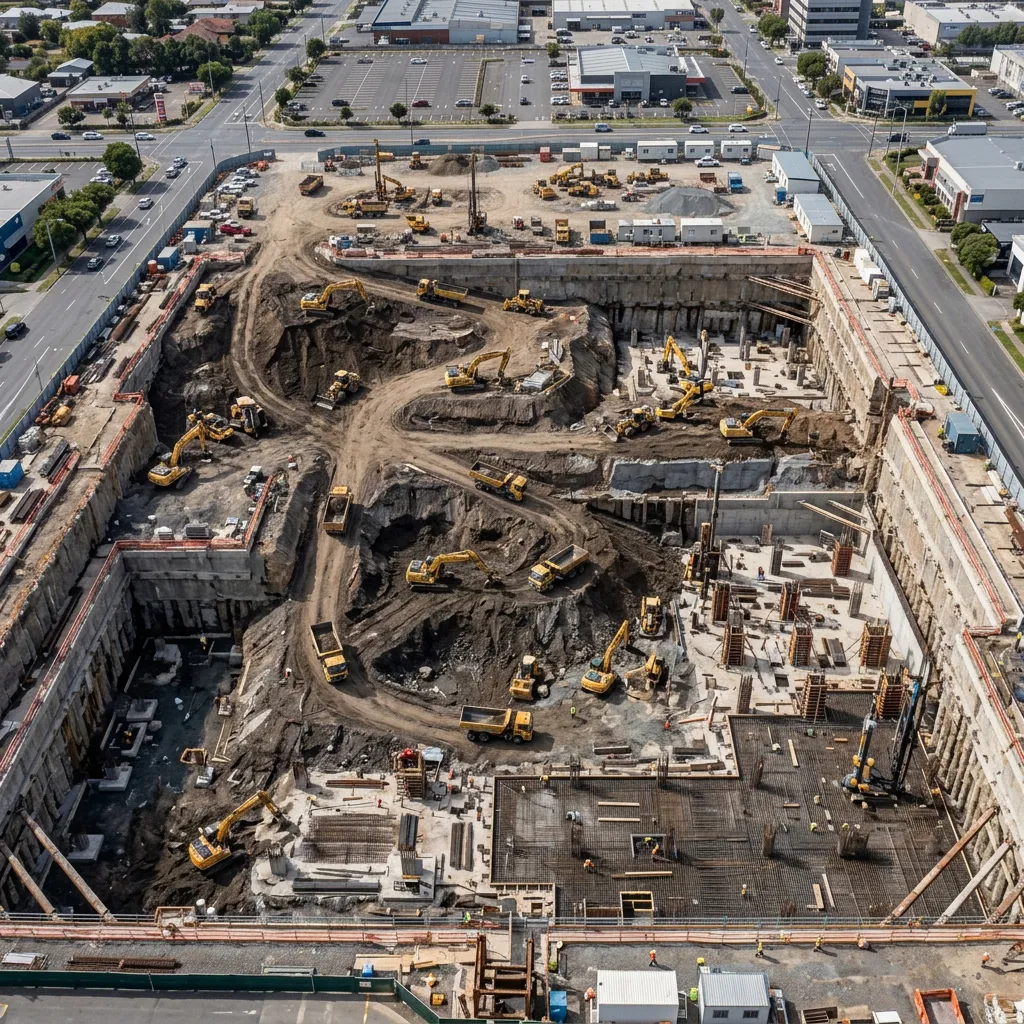
Dewatering services for construction sites in Coimbatore typically mean one of two systems: sump pumping for low-permeability clay and weathered rock, or vacuum wellpoint systems for sandy, water-bearing strata where a sump alone can't keep pace with inflow. Choosing the wrong system doesn't just slow a job down — it can destabilise an open-cut excavation and undermine the very foundation being poured. Coimbatore's mixed geology, from red loam to sandy alluvium along old stream courses, means the correct method changes from plot to plot even within the same locality. This piece covers how we select, size, and run dewatering on basement and deep-foundation excavations.
1 · Wellpoint Dewatering vs Sump Pumping: Choosing by Soil Permeability
Sump pumping — collecting seepage in perimeter sumps and pumping it out with submersible pumps — works reliably in low-permeability soils with a coefficient of permeability below roughly 10⁻⁴ cm/sec, typical of Coimbatore's weathered rock and stiff clay pockets, where inflow rates stay low enough that a few strategically placed sumps can keep an excavation dry. Once permeability rises into sandy or silty-sand strata, sump pumping starts drawing fines out of the surrounding soil along with the water, a process called piping that undermines excavation side slopes and can trigger localised collapse. At that point we switch to a vacuum wellpoint system: a ring of closely spaced small-diameter wellpoints connected to a header pipe under vacuum, lowering the water table uniformly across the excavation footprint before digging even begins, rather than chasing water after it has already entered the cut.
We confirm which regime applies through a combination of the geotechnical soil report and a simple field permeability check during the initial borehole programme, since relying on soil classification alone can be misleading where a site sits on a buried sand lens within an otherwise clayey profile. For deep basement excavations exceeding roughly 4-5 metres, we also model drawdown against the site's static water table depth, because wellpoint systems have a practical suction lift limit of about 6-7 metres per stage — deeper excavations need multi-stage wellpoint installations or deep bored relief wells rather than a single-stage ring.
2 · Vacuum Wellpoint Spacing Around a Basement Excavation Perimeter
Wellpoint spacing is set by soil grain size and the required drawdown rate, not a fixed rule of thumb. In fine sands typical of Coimbatore's alluvial pockets, we space wellpoints at roughly 1-1.5 metre centres around the excavation perimeter, jetted or bored to a depth that keeps the well screen below the target drawdown level with adequate penetration into the water-bearing stratum. Each wellpoint connects via a swing riser to a common header main running to a self-priming vacuum pump set, and we run at least one standby pump on every installation, since a pump failure on a live excavation with a rising water table is not a risk we accept on an active basement pour.
Drawdown is monitored through observation wells placed inside the wellpoint ring, checked daily against the target level before excavation proceeds to the next lift, and we do not allow digging to advance below the confirmed drawdown line. On sites adjoining existing structures, we also watch for settlement risk, since aggressive dewatering can consolidate loose granular soils beneath neighbouring foundations; where that risk is real, we throttle drawdown rate and extend the wellpoint ring further out from the excavation edge to flatten the cone of depression rather than concentrating it tight against a shared boundary, a precaution that matters on infill plots common across basement excavation projects in Coimbatore.
"A pump failure on a live excavation with a rising water table is not a risk we accept on an active basement pour."
3 · Discharge Water Filtration and Environmental Compliance
Dewatering discharge is not simply pumped to the nearest storm drain. We route pumped water through settling tanks or silt traps first, since discharging turbid, silt-laden water directly into a municipal drain or open watercourse causes downstream siltation and is a compliance issue under Tamil Nadu Pollution Control Board norms for construction site discharge. Settling tanks are sized to give at least 20-30 minutes of retention time at expected pumping rates, allowing suspended solids to drop out before the clarified water is released, and we periodically desilt the tanks so their retention capacity doesn't degrade mid-project.
Where a site sits near an existing stormwater channel or a low-lying residential area, we also plan discharge routing in advance with the client and, where required, the local civic body, rather than defaulting to whatever drain happens to be closest. On larger commercial excavations we log daily discharge volumes as part of the site's environmental record, since clients pursuing green-building certifications or corporate ESG reporting increasingly ask for this data as part of project handover documentation, and having it recorded from day one avoids a scramble to reconstruct it later.
4 · Monsoon-Season Dewatering Capacity Planning for Coimbatore Sites
Coimbatore's northeast monsoon between October and December can raise the shallow water table by a metre or more within days on sites near the Noyyal river basin and its tributary channels, so we size pump capacity against monsoon-peak inflow scenarios, not dry-season averages, on any excavation programmed to run through that window. That means specifying pump sets with headroom above calculated steady-state inflow — typically 25-40% additional capacity — and keeping a mobile standby pump on the yard roster that can reach any active site within a few hours of a capacity alert.
We also stage excavation sequencing around the monsoon calendar where the programme allows it, pushing the deepest, most water-sensitive excavation phases into the drier months and using the wetter months for above-ground work that doesn't depend on a dry cut. Where that sequencing isn't possible because of a fixed handover date, we install perimeter bunding and diversion channels to keep surface runoff from adding to the groundwater inflow the dewatering system already has to handle, since untreated surface water entering an open excavation compounds pumping demand fast during a heavy spell — a lesson reinforced on our own Sulur flood response.
5 · When to Stop Dewatering: Foundation Buoyancy and Mud-Mat Timing
Stopping dewatering too early is as damaging as starting it late. We keep the system running through placement of the mud-mat (the lean concrete blinding layer) and continue pumping until the raft or footing concrete has gained sufficient strength and, critically, until the structure has adequate dead-load or is otherwise anchored against hydrostatic uplift — a basement raft poured while the water table is artificially lowered can experience flotation or cracking once pumping stops and groundwater rebounds beneath it if this sequencing is rushed.
Our sequence is to maintain drawdown through blinding concrete, waterproofing membrane installation, raft or footing reinforcement and pour, and initial curing, only tapering pump operation once the structure has enough mass and, where designed, permanent underdrainage or a water-stop detail to resist buoyancy on its own. We coordinate this handoff point directly with the structural engineer's design assumptions rather than making a unilateral call on-site, since the allowable groundwater rebound rate is a structural input, not just a dewatering-crew decision, and getting it wrong is expensive to fix after the fact.
Operational Summary & Takeaways
Dewatering for construction sites in Coimbatore is a matter of matching the method to soil permeability, sizing pump capacity for monsoon-peak inflow rather than dry-season averages, and staying disciplined about when the system can safely be switched off. As a PWD Class-I licensed and First Class NHAI registered contractor operating across Coimbatore, Tiruppur, Erode, Salem, Pollachi, Karur, Namakkal, Dindigul, the Nilgiris, Mettupalayam, Sulur and Udumalpet, we run dewatering as an engineered part of the excavation programme, not a reactive fix once water appears. If you have a basement or deep-foundation excavation coming up, talk to us early through our contact page so dewatering is planned into the sequence from day one.