
Choosing a Civil Contractor for Renewable Energy Projects in Tamil Nadu
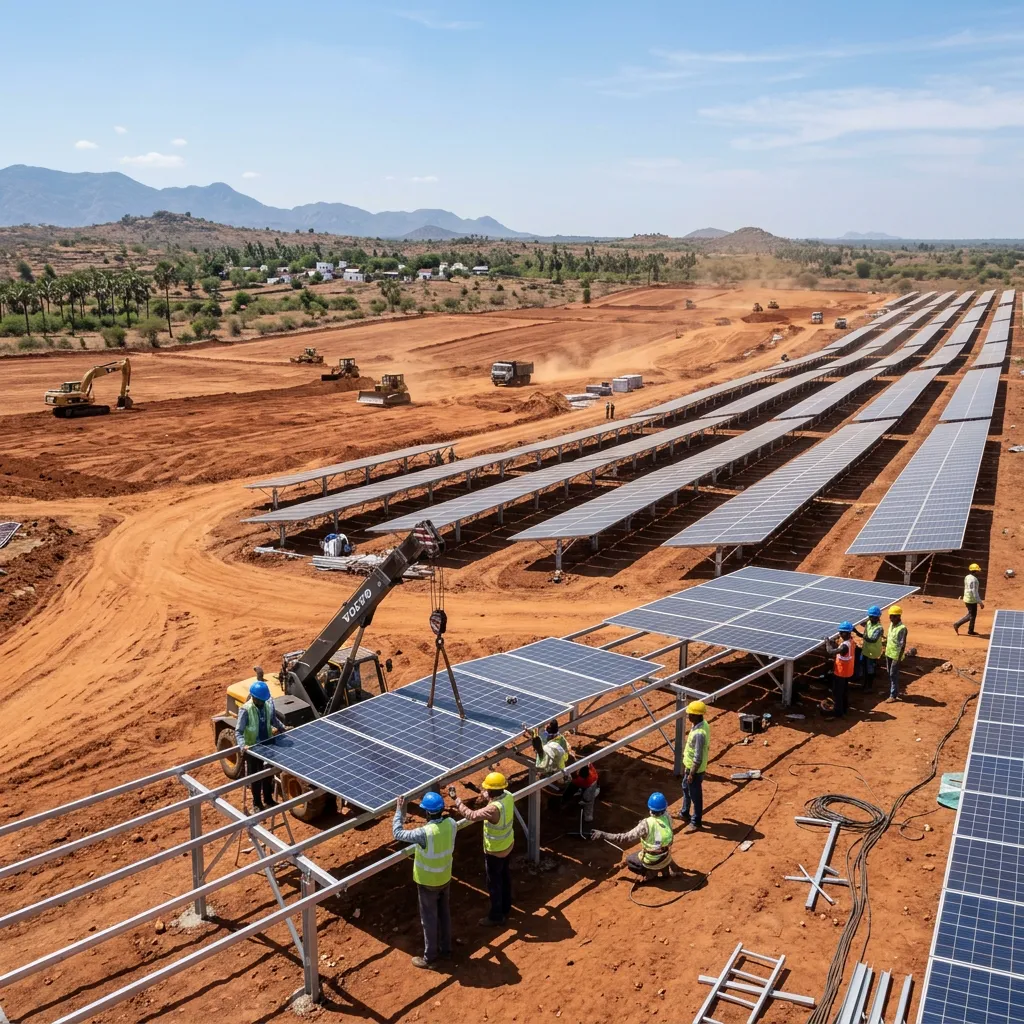
A civil contractor for renewable energy projects in Tamil Nadu has to deliver two things an EPC developer cannot skip: a grading and foundation package that survives the site's actual soil and rainfall conditions, and a construction schedule that syncs with equipment delivery and grid-connection deadlines. Get either wrong and the plant sits idle waiting on civil works while inverters or turbine nacelles depreciate in a laydown yard. We take on the civil scope of solar and wind projects across the state as a specialist package, separate from the electro-mechanical EPC contract, because the earthwork, drainage and foundation engineering involved is closer to road and industrial-site construction than to power engineering.
1 · Civil Scope in a Renewable Energy EPC Contract: What's Included
The civil package on a solar plant typically covers boundary fencing and access gates, internal haul roads, module mounting structure (MMS) foundations, inverter and transformer plinths, control-room and substation foundations, cable trench excavation and reinstatement, and stormwater drainage sized to the site's catchment area. On a wind project the civil scope shifts toward heavier structural work: turbine base rafts, crane hardstand pads compacted to a bearing capacity the crane manufacturer specifies, and access roads built to the turning radii and axle loads that blade and nacelle transport trailers require. Both scopes also carry site development work — topsoil stripping, cut-and-fill grading, and erosion control — that has to be completed and stabilised before any foundation excavation opens.
We treat this as a distinct trade package rather than an add-on to general contracting, because the tolerances differ from a typical building or road job. MMS pile foundations, for instance, are set out on a grid with row-to-row alignment tolerances tight enough that a few centimetres of drift across a long array row compounds into module misalignment by the time you reach the end of the row. Cable trench depths and bedding sand thickness are dictated by the DC cable manufacturer's installation guide, not by a generic trenching SOP, so our site engineers work off the electrical contractor's cable schedule rather than a standard drawing. Getting this handoff right early avoids rework once conduits are already buried.
2 · Site Clearing and Grading Timelines for Wind vs Solar Projects
Solar sites in the Kongu belt are usually flatter agricultural or scrub land, so clearing and grading move fast once possession is handed over — grubbing, topsoil stripping to 150-200mm, and rough grading to design contours can cover a sizeable array field within a few weeks using a bulldozer-and-motor-grader combination, provided the soil doesn't need import fill. Wind sites are a different problem entirely. Turbine locations sit on ridgelines or elevated terrain chosen for wind resource, which means access roads have to be cut and benched along gradients, often through rocky or lateritic ground that needs rock-breaker attachments rather than plain dozing.
Because wind turbine components arrive on oversized trailers, the access road specification is set by the transporter, not by us — typical requirements call for a running width of around 6 metres, curve radii wide enough for a 60-70 metre trailer-and-load combination to negotiate, and cross-slopes kept within a narrow band so a nacelle load doesn't shift in transit. We grade and compact these roads to a proof-rolled subgrade before any base course goes down, since a road that settles under a multi-axle turbine transporter mid-delivery can delay an entire wind farm's commissioning schedule by weeks. Solar civil timelines, by contrast, are governed more by array-field drainage design than by transport geometry.
"A road that settles under a multi-axle turbine transporter mid-delivery can delay an entire wind farm's commissioning schedule by weeks."
3 · Foundation Types: Ground-Mount Piling vs Wind Turbine Base Rafts
Ground-mount solar foundations are almost always driven or bored piles — either galvanised steel screw piles or C-piles driven with a pile-driving rig, embedded 1.2 to 2 metres depending on the geotechnical report's uplift-resistance calculation, since wind loading on module rows (not gravity load) governs the design. In looser or sandy soils we shift to cast-in-situ pedestal footings poured against a bored hole, because driven piles can't achieve reliable set in loose strata. The choice between the two is made only after a soil investigation, and it's one reason we insist on a geotechnical report before quoting foundation rates — the same discipline we apply on any project where the soil report has to be read before you break ground.
Wind turbine base rafts are an entirely different order of structure: a reinforced concrete octagonal or circular raft typically 18-22 metres in diameter and 2.5-3.5 metres deep at the centre, holding several hundred cubic metres of concrete poured in a single continuous operation to avoid cold joints in a structure that has to resist decades of cyclic overturning moment from the rotor. This demands a batching plant with enough sustained output on site, temperature-controlled concrete in hot months to control the heat of hydration in such a large pour, and a compacted, proof-tested formation below the raft that the turbine OEM's civil design has explicitly approved. There is no room for a foundation redo once the tower erection crane is mobilised.
4 · Coordinating Civil Milestones with EPC and Grid-Connection Schedules
Renewable projects run on a schedule set by the power purchase agreement and the transmission utility's grid-connection date, not by the civil contractor's own pace, so our project managers work off the EPC's master schedule rather than issuing an independent one. Foundation completion dates are pinned to the equipment supplier's delivery windows — module mounting structures, inverters, or turbine nacelles arrive on fixed shipping schedules, and a foundation that isn't ready when the trailer shows up means demurrage charges and a laydown-yard storage problem nobody wants. We build float into our own sequencing specifically around monsoon risk, since a single missed week of grading during the northeast monsoon can cascade into a missed equipment delivery slot two months later.
Cable trenching and conduit-laying has to be finished and backfilled ahead of the electrical contractor's cable-pulling schedule, which means our civil crew and the EPC's electrical crew are effectively working the same corridor in sequence, not parallel. We hold weekly coordination meetings with the EPC site team through the grading and foundation phase specifically to flag any drawing changes — module layout revisions are common on solar projects as the electrical design gets finalised, and a late layout change can mean re-pegging pile positions that are already set out. Locking this coordination loop early is, in our experience, the single biggest factor separating a renewable civil package that finishes on time from one that doesn't.
5 · Track Record: What to Ask a Contractor About Past Renewable Projects
When evaluating a civil contractor for a solar or wind package, ask specifically whether their crews have handled MMS pile installation at the volumes a utility-scale array requires — a mid-sized ground-mount plant can call for several thousand pile positions, and a contractor whose pile-driving rig and crew are used to one-off building foundations will underestimate how different that production rhythm is. Ask, too, how they sequence trenching against an evolving electrical layout, and whether their site engineers can read a geotechnical report and translate uplift-resistance numbers into a pile embedment depth without waiting on a structural consultant for every location.
It's also worth asking what equipment the contractor owns outright versus hires per project — foundation and grading work on a renewable site runs on a tight schedule, and a contractor who has to hire in a pile-driving rig or a batching plant on short notice introduces a scheduling risk that's avoidable. We run this scope with our own fleet of excavators, motor graders, and concrete batching capacity rather than sub-hiring the core earthmoving and concreting equipment, which keeps us in direct control of the sequencing our EPC partners depend on. If you're scoping a renewable project's civil package, reach out to discuss the site specifics before finalising your grading and foundation budget.
Operational Summary & Takeaways
Choosing a civil contractor for a renewable energy project in Tamil Nadu comes down to scope clarity, foundation engineering discipline, and a schedule that's genuinely synced to the EPC's equipment-delivery and grid-connection dates rather than run independently. As a licensed PWD Class-I civil contractor and First Class NHAI road contractor with an owned fleet of over 85 machines, Sri Vari Constructions takes on solar and wind civil packages across Coimbatore, Tiruppur, Erode, Salem, Pollachi, Karur, and the wider Kongu belt, including projects like the ones covered in our solar park civil works notes from Udumalpet. For a scoping discussion on grading, foundations, or access-road design for your renewable project, visit our services page or get in touch directly.