
Civil Works for Solar Parks in Udumalpet
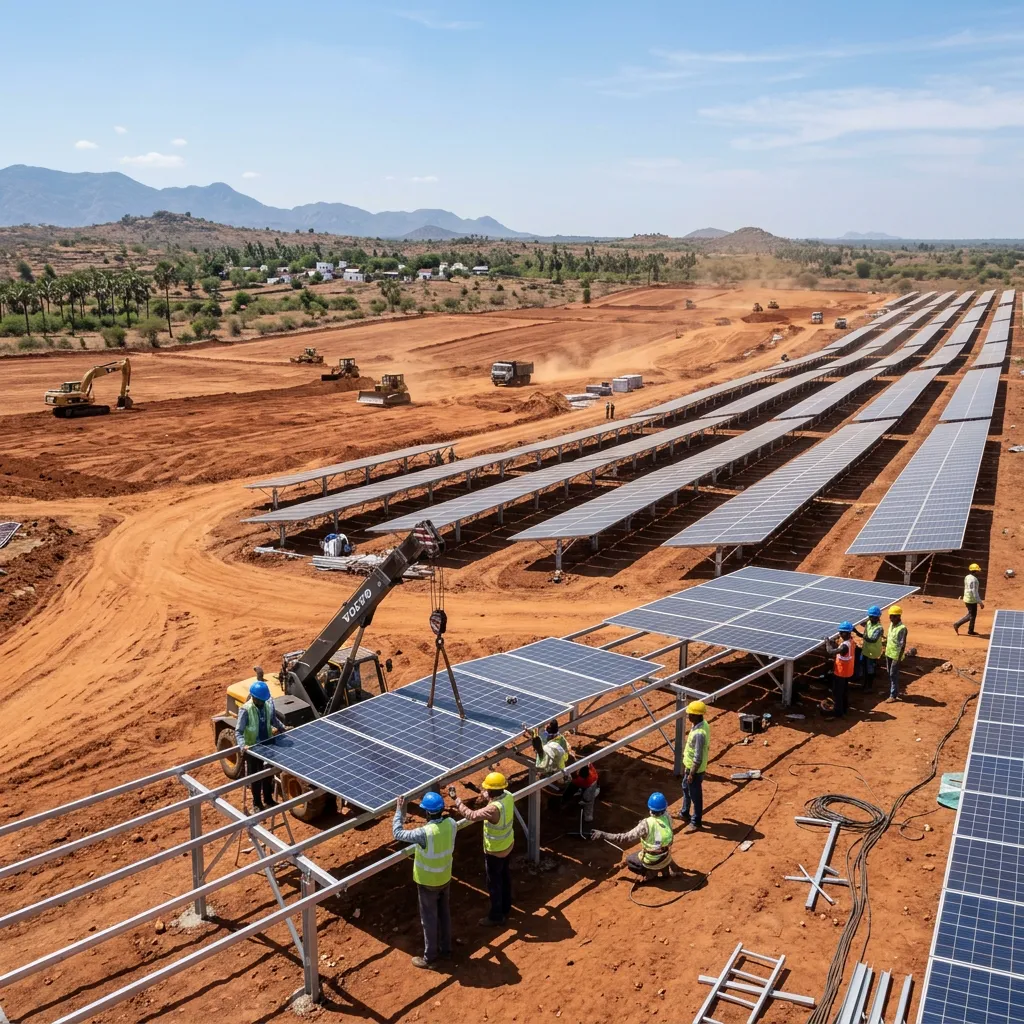
Civil works for solar parks in Udumalpet start with large-area grading, not module installation, because a ground-mounted array's foundation piles and access roads have to be complete and stable across the entire site before the EPC contractor can begin racking. Udumalpet's terrain along the Pollachi-Udumalpet belt mixes open scrubland with pockets of rocky outcrop, so the earthwork scope on any given solar plot can range from straightforward grading to systematic rock breaking, and pricing that without a proper site walk leads to budget overruns once piling starts. We scope solar civil packages as a single coordinated programme — grading, access roads, trenching and drainage — rather than as separate line items handed to different subcontractors.
1 · Large-Area Grading for Ground-Mounted Solar Array Foundations
Ground-mounted solar arrays tolerate far less grade variation across a table row than a typical earthworks project, since the racking system's tracker or fixed-tilt structure is only designed to accommodate a limited slope tolerance — commonly within 3-5% along the row and tighter across it — before the mounting brackets run out of adjustment range. We rough-grade the full plot to the drainage fall the layout requires, then fine-grade each row line to the tolerance the EPC's racking supplier specifies, checking finished grade with survey-grade GPS or total station rather than relying on visual levelling across a site that can run to tens of hectares. Cut-and-fill balancing is planned across the whole footprint before earthwork starts, since importing or exporting fill on a 50-hectare-plus solar site is a cost line large enough to change the project's economics if the balance isn't optimised at design stage.
Compaction requirements on a solar site are lighter than under a building foundation but still matter, particularly along access roads and around inverter and transformer pad locations, where we compact to at least 90-95% of Standard Proctor density depending on the EPC's specification. We also preserve natural drainage lines through the grading plan wherever possible instead of flattening the entire site to one uniform level, since retaining some of the site's natural fall reduces the size of the constructed drainage network needed later and keeps runoff behaving predictably across the array field.
2 · Rocky Terrain Clearing and Piling Access Roads in Udumalpet
Where a Udumalpet plot's soil profile transitions into weathered or hard rock within the pile embedment depth — common on the rockier fringes toward the foothills — we bring in hydraulic rock breakers ahead of the piling rig rather than letting the pile-driving crew discover the obstruction row by row, since a stalled piling crew on a large array is one of the most expensive delays an EPC schedule can absorb. Rock outcrops that can't be economically broken are surveyed and flagged early so the EPC's layout engineer can adjust row spacing or substitute a different foundation type — such as a ballasted or concrete pier footing — for that specific location rather than forcing every pile on the site to a single design.
Internal access roads connecting the site entrance to each block of the array have to support piling rigs, cable-laying equipment and, later, maintenance vehicles, so we build them to a compacted gravel or WBM standard capable of carrying tracked and wheeled construction plant in all weather, not a temporary cut track that washes out in the first monsoon. We lay these access roads early in the programme specifically because every other trade on a solar site — piling, racking, cabling, module installation — depends on being able to move equipment and material across the plot without delay, and a site that turns to mud during transport halts progress across every other work front simultaneously.
3 · Internal Cable Trenching and Inverter Pad Foundations
DC cable trenches running from each array row to the string combiner boxes and on to the inverter stations are excavated to the depth and route the EPC's electrical layout specifies, typically 450-600mm for DC runs and deeper for AC collector cabling, with sand bedding and warning tape laid per the cable manufacturer's installation guidance before backfill. We coordinate trench excavation sequencing tightly with the electrical contractor's cable-pulling schedule, since open trenches left uncovered too long on an active construction site become both a safety hazard and a source of trench-wall collapse if rain intervenes before backfill is complete.
Inverter and transformer pad foundations are reinforced concrete plinths sized and levelled to the specific equipment footprint and anchor bolt pattern the manufacturer supplies, cast on a compacted sub-base with cable entry ducts cast in at the correct position rather than core-drilled after the pour. We treat these pads with the same anchor-accuracy discipline we'd apply to any equipment foundation, because a misaligned duct or an out-of-tolerance anchor bolt on an inverter skid causes exactly the same kind of installation delay that a poorly set column base plate causes on a steel shed.
"A site that turns to mud during transport halts progress across every other work front simultaneously."
4 · Stormwater Management Across a 50+ Hectare Solar Site
A solar site of this scale changes the land's natural runoff pattern significantly — rows of tilted panels concentrate rainfall into drip lines rather than distributing it evenly, and compacted access roads and gravel pads shed water faster than the vegetated ground they replace — so we design the stormwater network around a return-period storm calculation rather than assuming natural drainage will cope unmodified. Swales run along the low side of each row block, feeding into collector channels sized against peak flow for the site's catchment area, ultimately discharging to a retention basin or the natural watercourse at a controlled rate that doesn't concentrate flow onto neighbouring agricultural land downstream.
Erosion control during construction is a separate concern from the permanent drainage design, since a graded but not-yet-vegetated site is at its most erosion-prone in the months between earthwork completion and the ground cover establishing under and around the panels. We install silt fencing and temporary check dams at drainage low points through the construction period, and we sequence final grading and access road gravelling ahead of the monsoon window wherever the project calendar allows it, since an under-drained solar site that erodes gullies through its access roads mid-construction is expensive and slow to repair once heavy equipment is already committed to the site.
5 · Coordinating Civil Handover with EPC Contractors on a Tight Schedule
Solar EPC contracts run on commissioning deadlines tied to power purchase agreements and subsidy windows, so our civil handover to the EPC's piling and racking crews happens block by block rather than waiting for the entire site to be grading-complete, letting racking installation start on finished blocks while grading continues on the rest of the site. We agree a block release sequence with the EPC at project kickoff — typically matching the order the EPC intends to install racking and modules — so our earthwork crews and their installation crews move across the site in the same direction rather than crossing paths.
Each block handover includes a survey record confirming grade tolerance, compaction test results, and access road readiness, which becomes the EPC's documented starting point for their own installation quality record. We keep this documentation discipline consistent across every block precisely because a solar civil scope this large inevitably runs multiple crews in parallel, and a missing or informal handover record on even one block is enough to create a dispute later about who was responsible for a grading defect discovered after racking is already installed on top of it.
Operational Summary & Takeaways
Civil works for solar parks in Udumalpet succeed when grading, access roads, trenching and drainage are planned as one coordinated programme against the EPC's block-by-block installation sequence, not treated as separate earthwork line items. As a licensed PWD Class-I civil contractor and First Class NHAI road contractor with 85 machines and 220 staff, Sri Vari Constructions delivers site development for renewable energy projects across Udumalpet, Pollachi and the wider Coimbatore district, applying the same approach outlined in our guide to choosing a civil contractor for renewable energy projects in Tamil Nadu and backed by accurate pre-grading survey work on every block. Contact us through our contact page to scope civil works against your EPC's commissioning timeline.