
GSB, WMM, DBM, BC: Tamil Nadu's Road Pavement Layers Explained
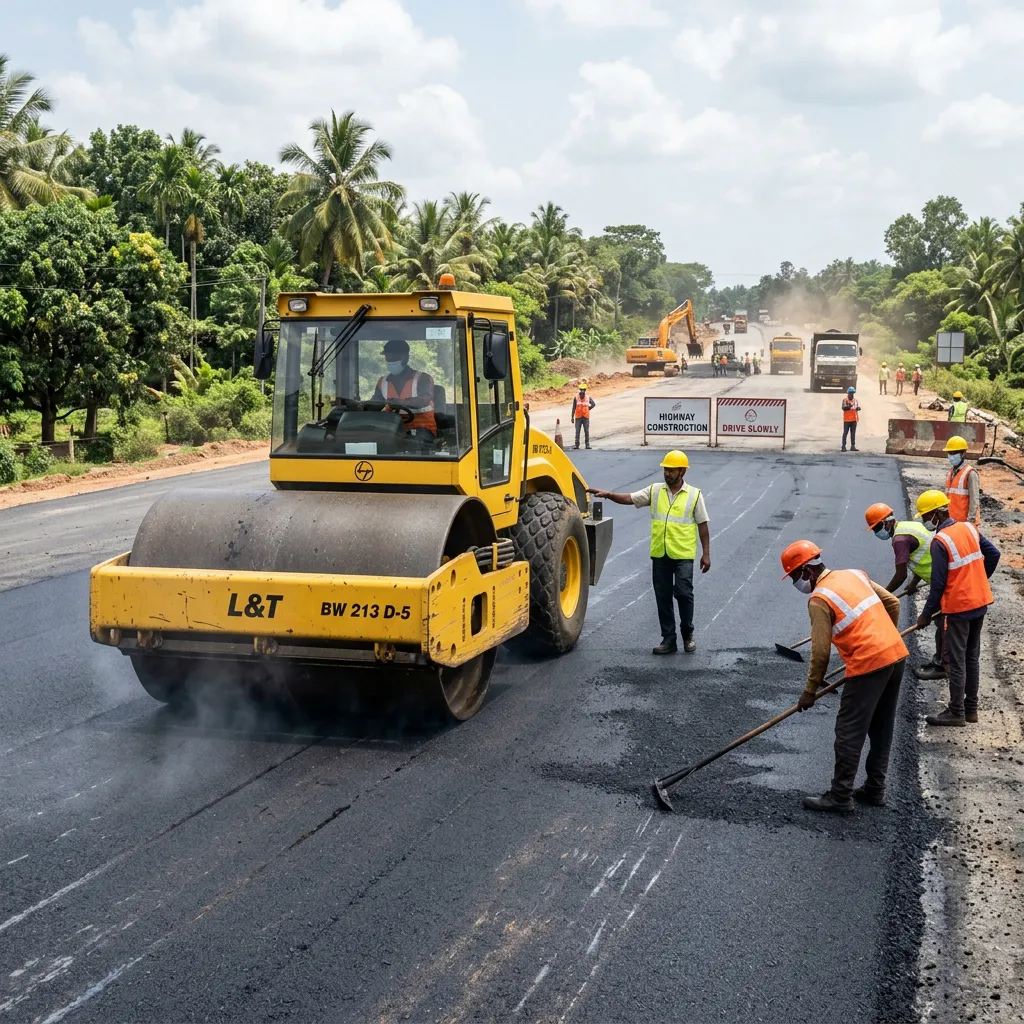
GSB, WMM, DBM and BC are the four layers, in build order from the subgrade upward, that make up a standard flexible road pavement in Tamil Nadu: Granular Sub-Base, Wet Mix Macadam, Dense Bituminous Macadam, and Bituminous Concrete. Each layer serves a distinct structural role and is specified with its own thickness, material gradation, and compaction target under MoRTH and IRC codes — skipping or under-building any one of them doesn't just weaken the road cosmetically, it shortens its structural life by years. This piece walks through what each layer does, why the order can't be changed, and how they're tested before the next one goes down.
1 · Granular Sub-Base (GSB): Purpose, Gradation and Compaction Targets
GSB sits directly on the prepared subgrade and is the first structural layer of the pavement, built to distribute traffic load over the weaker natural or improved subgrade beneath it while also acting as a drainage layer that keeps moisture from accumulating under the pavement structure. Under MoRTH specifications, GSB material is a well-graded mix of natural gravel, crushed stone, or a combination of both, conforming to one of the standard gradations set out in MoRTH Table 400-1, with the coarser Grading I or II typically preferred where drainage function matters most. Total GSB thickness generally ranges from 150mm to 300mm depending on traffic category and subgrade CBR (California Bearing Ratio), placed in compacted layers not exceeding 200mm loose thickness per lift so that compaction plant can achieve uniform density through the full depth.
Compaction of GSB is verified against the Modified Proctor maximum dry density, with field density required to reach at least 98% of the laboratory value, checked using sand replacement or nuclear density gauge methods at regular chainage intervals. We also run gradation checks on incoming material at the batching yard before it ever reaches the road, since a GSB layer built from out-of-envelope material can meet compaction density on test yet still perform poorly under repeated traffic loading because its load-spreading characteristics don't match design assumptions. Getting GSB right is foundational in the most literal sense — every layer above it inherits whatever structural weakness is built into this base.
2 · Wet Mix Macadam (WMM): Why It Sits Between GSB and Bituminous Layers
WMM is a denser, more tightly graded crushed-aggregate layer laid above GSB and below the bituminous courses, and it exists specifically to bridge the stiffness gap between a granular sub-base and a bound bituminous layer — laying bituminous material directly on GSB without a WMM course risks differential deflection under traffic that the bitumen layer alone can't absorb. The aggregate for WMM is mixed with water at optimum moisture content off-site or at a central plant, rather than dry-mixed on the road, which is what gives the layer its name and its more uniform, tightly interlocked density once compacted. Thickness typically runs 150mm to 250mm depending on design traffic, again placed and compacted in lifts, with gradation conforming to MoRTH Table 400-9.
WMM compaction is checked to the same 98% of Modified Proctor density standard as GSB, but with tighter attention to surface trueness and camber, since this layer's top surface becomes the working platform the bituminous paver runs on — any undulation left in the WMM surface telegraphs straight through the DBM and BC layers above it as a visible and structurally weak spot in the finished road. We also allow the WMM layer to be proof-rolled with a heavy roller before releasing it for the priming coat, since proof rolling exposes any soft or unstable pockets that density testing alone can miss.
"Any undulation left in the WMM surface telegraphs straight through the DBM and BC layers above it as a visible and structurally weak spot in the finished road."
3 · Dense Bituminous Macadam (DBM): The Structural Binder Course
DBM is the first bound, bituminous layer in the pavement and functions as the main structural binder course, carrying the bulk of the vertical and shear stresses transmitted down from traffic before they reach the granular layers below. It's laid over a tack or prime coat applied to the WMM surface, using hot mix asphalt produced at 150-165°C with VG-30 or VG-40 bitumen binder content typically around 4.0-4.5% by weight of mix, and aggregate gradation conforming to MoRTH Table 500-10 or 500-11 depending on the nominal maximum aggregate size selected for the design. Layer thickness for DBM commonly ranges from 50mm to 100mm, sometimes built up in two lifts on higher-traffic categories where a single lift would exceed practical compaction depth.
We run Marshall mix design in our lab to confirm the DBM mix meets minimum stability of 9 kN with an acceptable flow value before any batch goes to the road, and in-place field density is checked by core cutting to confirm it reaches at least 98% of the laboratory Marshall density — a target covered in more depth in our piece on bitumen temperature control during paving, since DBM's structural performance depends as much on compaction temperature discipline as on mix design. A well-compacted DBM layer resists rutting under heavy axle loads and forms the load-bearing backbone the thinner BC wearing course sits on.
4 · Bituminous Concrete (BC): The Wearing Surface and Its Tolerances
BC is the final wearing course, the layer that actually carries tyre contact and is directly exposed to weather, and it is specified to a tighter aggregate gradation and lower design air-void range than DBM, typically 3-6% air voids against BC's finer MoRTH Table 500-17 or 500-18 gradation envelope, since this layer needs to be both durable and skid-resistant rather than purely load-bearing. BC thickness is comparatively thin, usually 25mm to 40mm, laid as a single lift directly over the DBM course after a tack coat, and finished to strict surface tolerance requirements — MoRTH specifies a maximum allowable surface unevenness measured by a 3-metre straight edge, since even small undulations in the wearing course cause water ponding and accelerate raveling.
Camber and cross-slope, typically 2-2.5% on bituminous roads, are built into the BC layer's finished surface specifically to shed water quickly, and we check this with electronic sensors on the paver plus manual line-level spot checks along the alignment before the layer is accepted. Because BC is the layer road users actually see and feel, it's also where texture depth is measured — using the sand patch test to confirm adequate macro-texture for skid resistance — a check that matters as much for safety compliance as for the visual finish PWD and NHAI inspecting engineers look for at handover.
5 · How These Layers Work Together Under IRC:37 Pavement Design
IRC:37 is the governing Indian Roads Congress guideline for flexible pavement design, and it sets total pavement thickness and the thickness of each individual layer as a function of design traffic in million standard axles (MSA) and the subgrade's effective CBR value — a low-CBR subgrade, common where Tamil Nadu's black cotton soil is present, demands a thicker GSB and WMM package to compensate for the weaker foundation, which is why subgrade soil type is one of the first inputs we check before finalising a pavement design, not an afterthought. Each layer's modulus and thickness is modeled together in a multi-layer elastic system, meaning under-building one layer forces the others to work outside their design assumptions even if they were built exactly to their own individual specification.
This is why we treat GSB, WMM, DBM and BC as one integrated structural system during construction, not four separately managed contracts: subgrade CBR testing feeds the GSB and WMM thickness decision, WMM surface trueness governs how well DBM can be compacted, and DBM's density directly determines whether the thin BC wearing course will perform for its full design life or fail early under reflective cracking. On road construction projects we deliver end to end, this integrated sequencing is exactly what protects the client's investment across the full pavement design life rather than just the visible finish at handover.
Operational Summary & Takeaways
GSB, WMM, DBM and BC each carry a distinct structural job in a Tamil Nadu road pavement, and every layer's performance depends on the one beneath it being built correctly to gradation, thickness, and compaction specification — there is no shortcut that doesn't eventually show up as premature road failure. As a PWD Class-I licensed and First Class NHAI registered contractor, Sri Vari Constructions builds and tests every pavement layer to MoRTH and IRC:37 standards across Coimbatore, Tiruppur, Erode, Salem, Pollachi, Karur, Namakkal, Dindigul, the Nilgiris, Mettupalayam, Sulur and Udumalpet. If you're planning a road construction or resurfacing project and want a contractor that treats pavement design as one integrated system, reach out through our contact page.