
Road Resurfacing Contractor in Dindigul: When to Overlay vs Rebuild
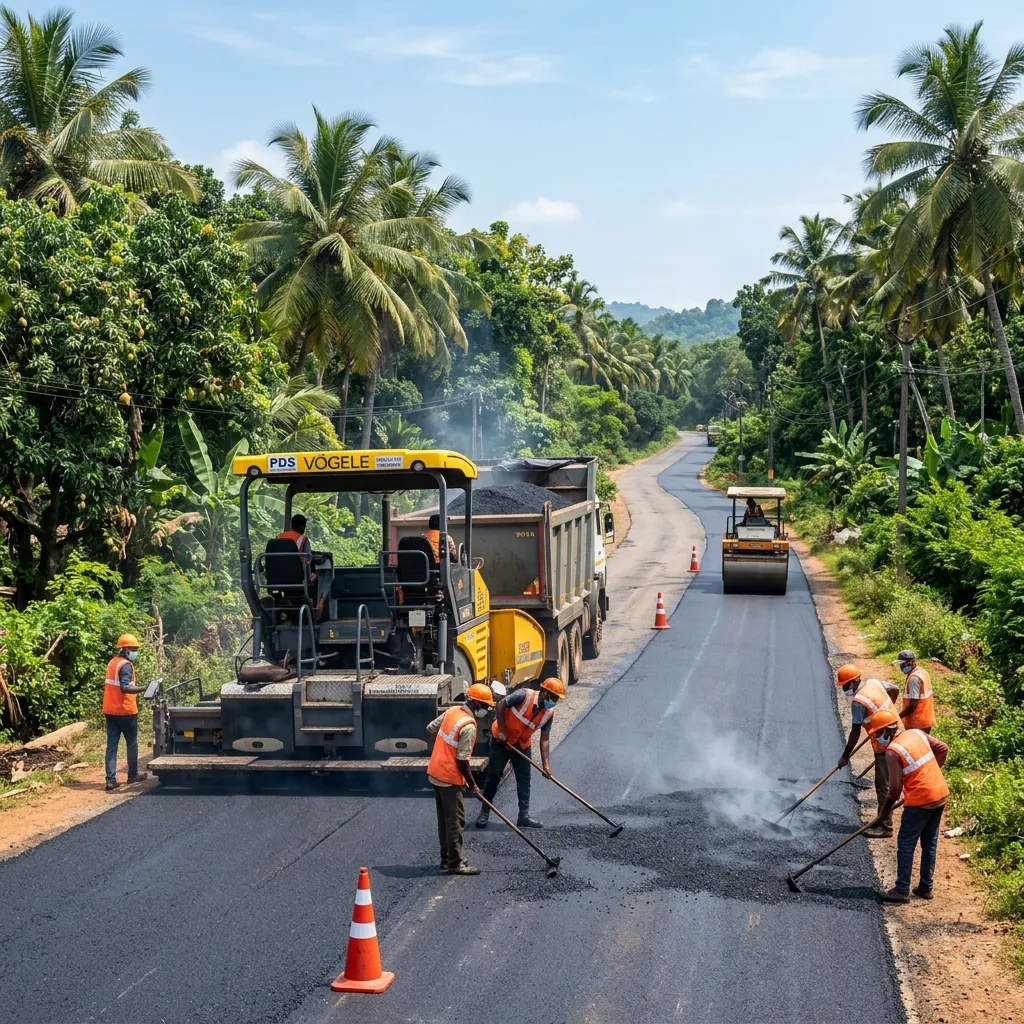
A road resurfacing contractor in Dindigul decides between an overlay and a full rebuild by reading the distress in the existing pavement, not by defaulting to whichever option is cheaper on paper. Surface-level cracking and mild rutting on a structurally sound base usually call for a milled overlay, while alligator cracking that has propagated through the full pavement depth means the base has failed and a fresh layer on top will crack through again within a season or two. We survey every stretch before quoting because Dindigul's mix of granite-quarry haul routes, agricultural produce corridors and older PWD roads each fail differently, and the wrong call wastes both the client's budget and the traffic disruption of a resurfacing crew on site.
1 · Diagnosing Pavement Distress: Rutting, Raveling and Alligator Cracking
Before we quote any resurfacing job, our site engineers walk the stretch and classify distress against the categories in IRC:82 and the MoRTH pavement maintenance manual — rutting depth measured with a straight edge across the wheel path, raveling assessed by how much aggregate has already dislodged from the surface, and cracking pattern checked to see whether it's isolated transverse cracking or the interconnected alligator pattern that signals base failure. Rutting beyond about 20mm under a 3m straight edge on a Dindigul haul route usually points to a subgrade or base problem rather than a surface one, since granite-laden trucks moving to and from the quarry belt push far higher axle loads than the pavement's original design traffic assumed. We log distress with GPS-tagged photographs chainage by chainage, which becomes the basis for the overlay-versus-rebuild recommendation we hand the client.
Alligator cracking is the distress type that changes our recommendation fastest, because once cracks have interconnected into a web pattern, water is already entering the base and subgrade through every joint, and any overlay placed on top traps that moisture rather than solving the problem. We also check for pumping — fines ejected at cracks under passing traffic, visible as staining around a crack — which confirms the subgrade has lost strength and is moving under load. A pavement showing isolated transverse or longitudinal cracking with no ejection of fines, by contrast, is usually still structurally sound and a strong overlay candidate.
2 · Overlay Thickness Design vs Full-Depth Reclamation Decision Criteria
Where the base is sound, we design the overlay thickness against the pavement's residual life using the effective structural number approach referenced in IRC:81 and IRC:37, factoring in the existing layer condition, projected traffic in msa (million standard axles) for the design period, and any pending change in axle loading — a real consideration on Dindigul routes feeding granite and tamarind processing units where truck volumes have grown faster than the road's original design traffic. A 40-50mm bituminous concrete (BC) overlay over a milled and tacked surface is typical for moderate distress; more severe but still base-sound sections may need a dense bituminous macadam (DBM) leveling course beneath the BC layer to correct rutting before the final surface goes down.
Once distress indicates base or subgrade failure, we recommend full-depth reclamation (FDR) or a complete rebuild rather than an overlay, because no surface treatment corrects a structural deficiency below it. FDR pulverizes the existing bituminous and granular layers in place, blends them with the underlying material, and — where warranted — stabilizes the reclaimed material with cement or lime before compacting it as a new base, which is often more economical on a stretch with a thick existing pavement than trucking that material out and importing fresh GSB and WMM. The decision point we give clients is simple: if crack depth and pumping indicate the base has failed, spending on an overlay only defers the rebuild cost by a year or two while adding the overlay cost on top of it.
"If crack depth and pumping indicate the base has failed, spending on an overlay only defers the rebuild cost while adding the overlay cost on top of it."
3 · Milling and Tack Coat Application Before a New BC Layer
Milling the existing surface before overlay is standard practice on any road that still has adequate kerb or shoulder clearance to accept a new layer without raising the finished level too far — we mill to a controlled depth, typically 30-50mm, using a cold milling machine that leaves a textured surface profile ideal for bonding rather than a smooth cut that a new layer can slip against. Milled material isn't wasted; reclaimed asphalt pavement (RAP) from Dindigul jobs is screened and, where gradation and binder content allow, recycled back into lower bituminous layers on other stretches, which keeps our material cost and environmental footprint down.
Tack coat application between the milled surface and the new BC layer is where a lot of resurfacing work quietly fails if rushed — we apply a bitumen emulsion tack coat at the rate specified in MoRTH Section 503, uniformly across the full width including against kerbs and around utility covers, and we do not allow paving to start until the tack has broken and cured to a tacky, non-fluid state. A missing or patchy tack coat is one of the most common causes of a new overlay delaminating from the old surface under traffic within months, showing up as slippage cracking or the new layer peeling at the edges, and it is entirely avoidable with correct application rate and timing.
4 · Traffic Management and Night-Shift Paving on Live Dindigul Roads
Resurfacing a live road through Dindigul town or along a busy quarry haul route means the traffic management plan is drawn up before the milling machine ever mobilizes — half-width working with signage, cones and flagmen on lower-volume stretches, or full closures with a signed diversion route on sections where half-width paving would leave an unsafe longitudinal joint under moving traffic. We coordinate closure timing and diversion routes with the local PWD division and traffic police in advance, since an unannounced lane closure on a haul route serving granite trucks backs up traffic fast and generates complaints that can stall a project's progress payments.
Where daytime traffic volume makes any lane closure impractical, we shift paving to a night window, typically starting after the evening peak and finishing the compaction and rolling sequence before the morning traffic build-up, with floodlighting rigs and a tighter quality-control routine since low light makes visual checks on mat texture and joint quality harder. Bitumen and mix temperature control matters even more on a night shift because ambient cooling is faster, so we compress the haul-to-lay-to-roll window and monitor mix temperature at the paver more closely than we would on a daytime pour — a discipline we apply consistently, since bitumen temperature control failures are one of the most common causes of premature pavement distress we get called back to diagnose.
5 · Warranty Periods and Post-Resurfacing Quality Checks
Every resurfacing job we hand over comes with a defect liability period during which we remain responsible for premature failures — delamination, rutting beyond tolerance, or raveling — that trace back to workmanship rather than traffic loading beyond design assumptions. Before handover we run core sampling at intervals along the completed stretch to confirm layer thickness and compaction density against the design, checked against MoRTH's field density requirement of at least 97% of laboratory density for BC layers, and we retain those core records as part of the project's quality file in case a defect claim arises later.
Post-monsoon inspection is where resurfacing quality genuinely shows, since standing water at low spots or edge cracking that opens up after the first heavy rain reveals compaction or drainage issues an initial visual inspection can miss. We schedule a follow-up walk-through with the client roughly one monsoon cycle after handover specifically to catch and close out any such defects while they're still within the liability period, rather than waiting for a complaint to come in. This closes the loop on a resurfacing job the same way we'd want it closed if we were the client footing the bill.
Operational Summary & Takeaways
Choosing the right road resurfacing contractor in Dindigul comes down to whether that contractor diagnoses pavement distress properly before quoting, because an overlay on a failed base is money spent twice. As a licensed PWD Class-I civil contractor and First Class NHAI road contractor, Sri Vari Constructions runs milling, overlay and full-depth road construction and resurfacing work across Dindigul, Karur and the wider Kongu belt, applying the same temperature and compaction discipline covered in our note on bitumen temperature control and current MoRTH pavement guidelines to every stretch we resurface. Get in touch through our contact page for a pavement condition survey before your next resurfacing tender.