
Rural Road Construction in Mettupalayam Taluk
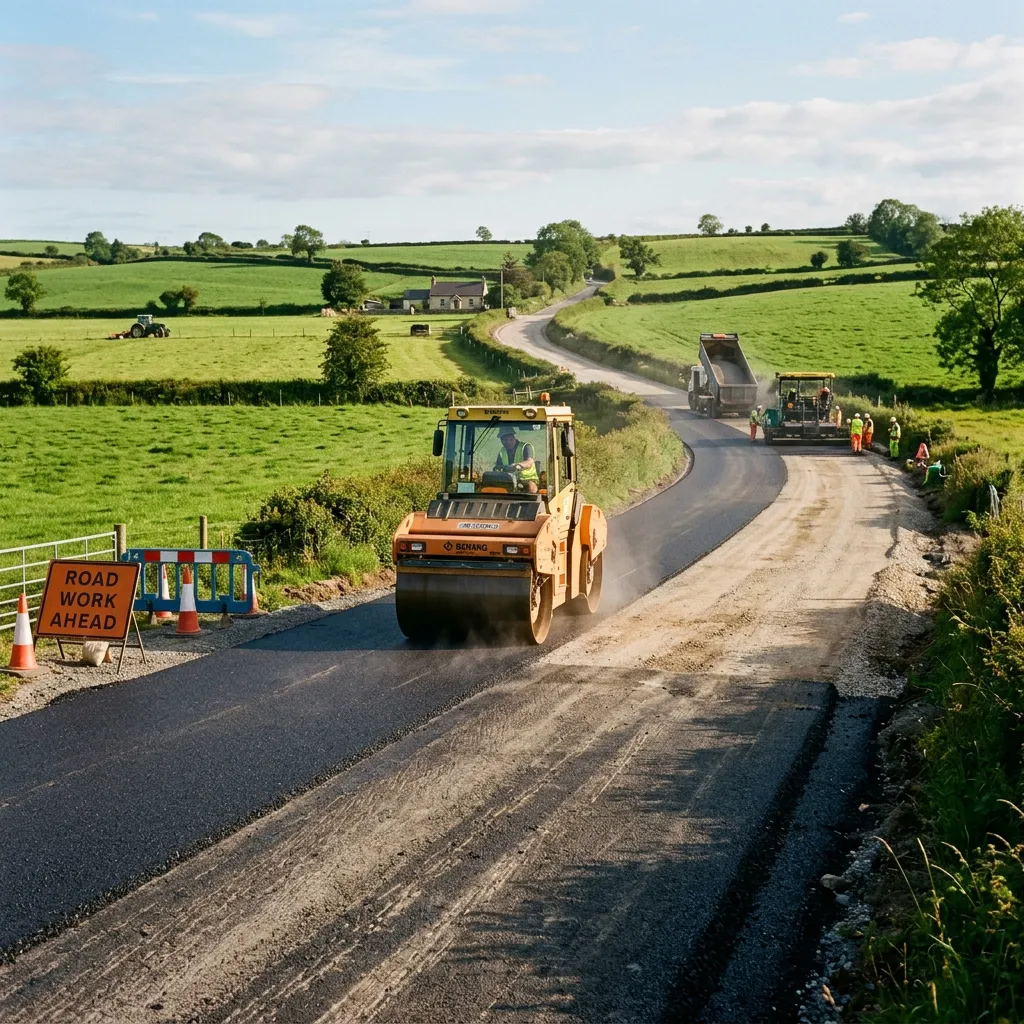
Rural road construction in Mettupalayam has to account for the taluk's foothill terrain from the very first survey, since the same stretch of link road can run flat farmland for two kilometres and then climb toward the Nilgiris approach in the next, changing subgrade, drainage and pavement requirements along the way. We build panchayat link roads and other rural stretches here against PMGSY and Tamil Nadu state scheme specifications, but the specification alone doesn't account for a stream crossing or an unstable cut slope — those come from walking the alignment before design is finalised. A rural road built without that walk-through tends to fail first at exactly the points a desk-based design missed.
1 · Panchayat Link Road Specifications Under PMGSY/State Schemes
Rural link roads under the Pradhan Mantri Gram Sadak Yojana and equivalent Tamil Nadu state schemes follow a defined cross-section — typically a 3.75m single-lane carriageway with 1.5m earthen shoulders on either side for low-volume roads, widening where the traffic census and connectivity criteria justify it — and a pavement design keyed to the specific CBR (California Bearing Ratio) value of the subgrade soil along that stretch rather than a blanket thickness applied district-wide. We test subgrade CBR at intervals along the alignment because red loam and lateritic soils common around Mettupalayam can vary enough over a few hundred metres to change the granular sub-base thickness the design calls for.
Camber, cross-fall and the earthen shoulder profile are specified precisely in the PMGSY rural roads manual because a rural road's biggest long-term threat is water sitting on or infiltrating through the pavement rather than traffic load itself, so we hold camber to the 2.5-3% range specified and make sure side drains are cut to carry runoff clear of the pavement edge rather than letting it pond against the shoulder. Where a stretch runs through a village settlement, we coordinate the road cross-section with any existing or planned drainage and utility crossings so the pavement structure isn't compromised by a service trench cut through it after construction.
2 · Foothill Terrain Grading Near the Nilgiris Approach Roads
Stretches of Mettupalayam taluk closest to the Nilgiris approach carry noticeably steeper natural grades and more variable cut geology than the open plains further into the taluk, so our earthwork planning for these sections includes a slope stability check on any cut exceeding roughly 1.5m in height, particularly where the cut face exposes weathered rock or a soil profile prone to slumping once exposed to monsoon runoff. We batter cut slopes to an angle appropriate to the exposed material rather than a single default gradient, and where a cut is long or the material is marginal, we add toe drains or, on the more exposed sections, gabion or dry-stone pitching to control surface erosion before vegetation can establish.
Grading through this foothill terrain also means managing longitudinal gradient against the vehicle types the road actually serves — bullock carts, two-wheelers, light goods vehicles and the occasional bus on a panchayat road — so we keep gradients within the rural roads manual's recommended limits and add passing bays on longer climbing sections where the carriageway width alone wouldn't safely allow two vehicles to pass. Retaining the natural drainage pattern down the hillside as much as possible, rather than concentrating all runoff into a single cross-drainage point, spreads the hydraulic load across more culverts and reduces the risk of any single structure being overwhelmed in a high-intensity storm.
"A rural road built without walking the alignment tends to fail first at exactly the points a desk-based design missed."
3 · Low-Volume Road Pavement Design: WBM vs Thin BC Overlay
For genuinely low-traffic panchayat link roads, a water bound macadam (WBM) surface — compacted graded aggregate with a screening and binding course, rolled to a tight, interlocked finish — remains a defensible and economical choice under IRC:SP:20 guidance for rural roads, particularly where budget or maintenance capacity favours a lower-cost surface that panchayat staff can periodically re-grade and re-blind rather than a bituminous surface requiring specialist repair. Where traffic has grown beyond the original design assumption, or where a stretch passes through a settlement with year-round pedestrian and two-wheeler use, we recommend a thin bituminous concrete (BC) or surface dressing overlay over the WBM base instead, since a sealed surface resists monsoon erosion and pothole formation far better than an exposed WBM crust under sustained traffic.
The decision between the two isn't purely a budget call — we factor in maintenance access, since a WBM road that a panchayat can realistically maintain with local labour and a road roller may outperform an under-maintained bituminous road that develops potholes nobody has the equipment to patch properly. On stretches we've resurfaced from WBM to BC under upgrade schemes, the base course condition is checked first exactly as we would on any resurfacing job, since a WBM base that has lost interlock or has soft pockets needs correction before a bituminous layer goes on top of it.
4 · Culvert Placement for Seasonal Hill Stream Crossings
Mettupalayam taluk's proximity to the Nilgiris means several rural alignments cross seasonal hill streams that run dry for much of the year and then carry a genuinely heavy flow during the northeast monsoon, so culvert sizing here is based on catchment area and peak discharge calculation rather than the visible width of the dry-season stream bed, which badly understates the structure a monsoon flow actually needs. We size RCC pipe culverts or slab culverts against IRC:SP:13 guidance for rural road cross-drainage structures, and on streams with a history of carrying debris or boulders during flash flow, we favour a box or slab culvert over a pipe culvert since the larger clear opening resists blockage far better.
Culvert invert level and approach road gradient are set together, not independently, so the road doesn't dip below the culvert's headwater level during a design flood event and get overtopped — a failure mode that both damages the pavement and cuts off the village the road serves for however long the water takes to recede. Wing walls and apron protection at both the inlet and outlet are sized to prevent scour undermining the structure's foundation, a detail that matters more on Mettupalayam's steeper stream gradients than it would on a flatter plains crossing, where flow velocity and scour potential are both naturally lower.
5 · Community Coordination on Narrow Rural Rights-of-Way
Rural rights-of-way in Mettupalayam's villages are often narrower than the design cross-section calls for, hemmed in by field boundaries, compound walls or trees that predate the road scheme, so early coordination with the panchayat and affected landowners is as much a part of our project start-up as the survey itself. We attend the panchayat's pre-construction meeting to walk through the alignment, flag any width constraint or structure encroaching on the right-of-way, and agree a resolution — minor realignment, boundary adjustment, or a formal width reduction where the traffic volume justifies it — before construction crews mobilise rather than discovering the conflict mid-build.
Construction staging around village sections also needs community input, since a full closure through a settlement cuts off access to homes and fields for the duration, so we sequence work in shorter sections and maintain a passable diversion or temporary access track wherever the geometry allows it. This is the same principle we apply on panchayat link road projects across the wider Kongu region — a rural road contractor's community relations during construction directly affect how smoothly the finished road gets accepted and maintained afterward.
Operational Summary & Takeaways
Rural road construction in Mettupalayam demands the same specification discipline as any PWD or NHAI package, adapted to foothill terrain, seasonal stream crossings and narrow village rights-of-way that a flat plains alignment never has to solve. As a licensed PWD Class-I civil contractor and First Class NHAI road contractor, Sri Vari Constructions builds panchayat link and rural road construction across Mettupalayam, Sulur and the wider Coimbatore district, and our approach to pricing rural roads reflects exactly the terrain and drainage variables covered here. Contact us through our contact page to discuss a rural road or link road project in your taluk.