
Demolition Contractor for Old Textile Mills in Coimbatore
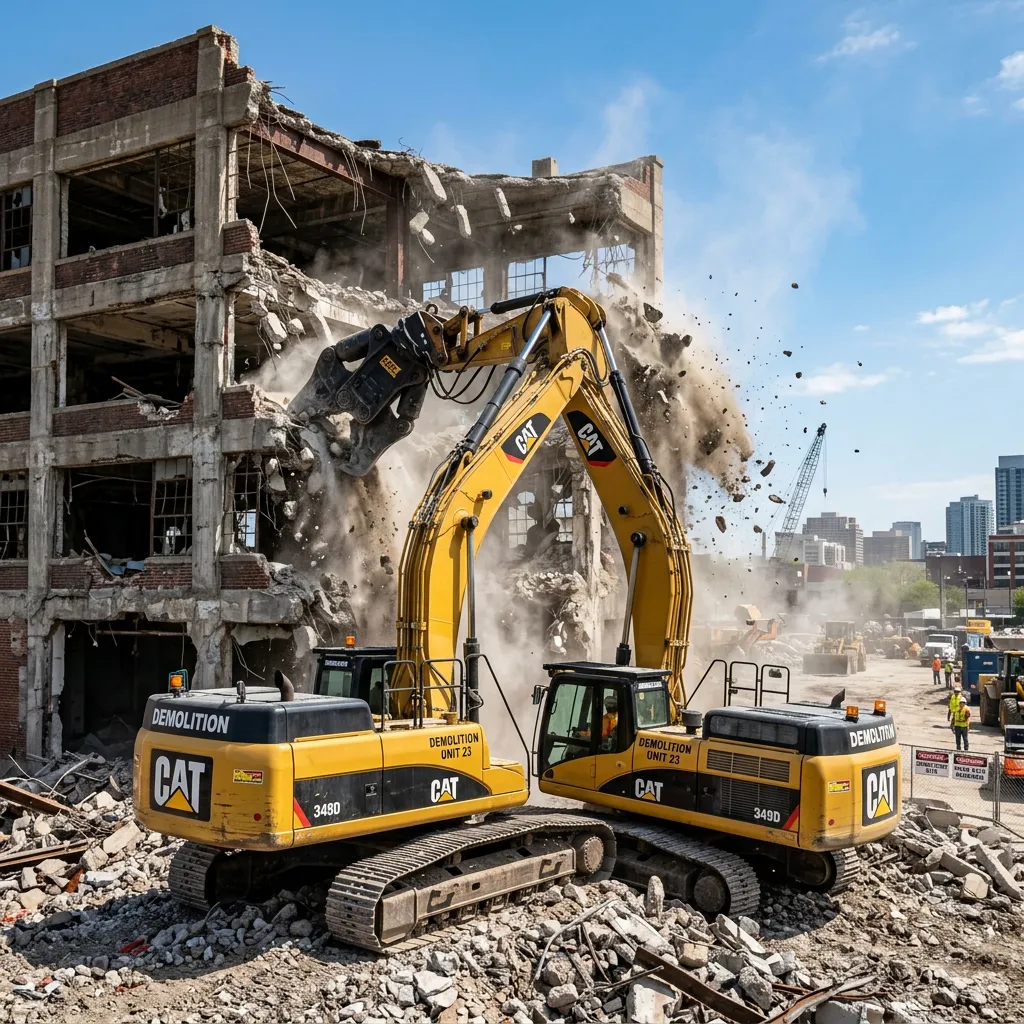
A demolition contractor for textile mills in Coimbatore needs to plan around structures that were never designed with demolition in mind: mill-era RCC columns and roof trusses built between the 1950s and 1980s, asbestos cement roofing sheets on nearly every shed, and often a live, operating mill section sharing a compound wall with the block being demolished. Coimbatore's "Manchester of South India" legacy left the city with dozens of these single-storey saw-tooth-roof mill sheds now being cleared for warehouse and industrial redevelopment. This piece covers how we approach a Coimbatore textile mill demolition, from structural assessment through asbestos handling, steel salvage, and a site clearance ready for the next tenant's civil works.
1 · Structural Assessment of Legacy Mill-Era RCC and Steel Trusses
Before any demolition method is chosen, we carry out a structural assessment of the mill building's RCC columns, floor slabs, and steel or RCC roof trusses, since mill-era construction from the mid-20th century predates current IS design codes and was frequently modified over decades of operation — additional floor loading, mezzanine insertions, and machine foundation changes that don't appear on any surviving drawing. We check for concrete carbonation and corrosion of embedded reinforcement, common in structures this age exposed to humid, dust-laden textile mill atmospheres, since a column that looks sound on the surface can have significantly reduced load capacity at its core. This assessment determines whether the structure can safely support workers and machinery during a staged manual and mechanical demolition, or whether it needs to be brought down by controlled mechanical pulling from the outset.
Saw-tooth roof trusses — the distinctive north-light roof profile common to Coimbatore mill sheds — present a particular sequencing challenge, since their long-span steel or RCC members are often under residual stress that releases unpredictably once supporting purlins or adjacent bays are removed. We sequence truss removal bay by bay with the excavator positioned to catch or control each section as it's cut free, rather than attempting a wide open span removal in one lift. This structural-first approach is consistent with the assessment discipline we apply on all demolition work, covered more generally in our piece on the cost of building demolition in Coimbatore.
2 · Asbestos Roofing Sheet Identification and Safe Removal
The great majority of Coimbatore textile mill sheds are roofed with asbestos cement (AC) corrugated sheets, installed decades before asbestos health risks were widely regulated, and these sheets require identification and handling as a distinct, sequenced task before any mechanical demolition of the structure beneath begins. We identify and mark all AC sheet roofing during the initial site walk, and removal is carried out by trained personnel using wet-cutting or whole-sheet removal methods that minimise fibre release, avoiding breakage, dry-cutting, or dropping sheets from height, all of which generate airborne asbestos dust.
Removed AC sheets are lowered rather than dropped, stacked, and wrapped for transport to a facility equipped to handle asbestos-containing waste rather than mixed with general construction debris, since co-mingling asbestos waste with ordinary demolition rubble creates contamination across the entire debris stream. Workers on asbestos removal tasks use respiratory protection and disposable coveralls for the duration of that specific work, and this sequencing — asbestos roof removal fully complete before structural demolition begins beneath it — is non-negotiable on every mill project we take on, regardless of schedule pressure from the client to move faster.
"Asbestos roof removal fully complete before structural demolition begins beneath it is non-negotiable on every mill project we take on, regardless of schedule pressure."
3 · Salvaging Structural Steel and Machinery Foundations for Resale
Textile mill demolition generates meaningfully more recoverable steel than a typical residential or commercial demolition, since mill sheds carry substantial structural steel in roof trusses, purlins, and often overhead crane runway beams from the mill's operating days, along with heavy embedded machinery foundation anchors and baseplates from looms, spinning frames, or processing equipment long since removed. We separate structural steel from RCC debris at the point of demolition rather than after, since steel mixed into a general rubble pile is far more labour-intensive to recover and loses scrap value through contamination with concrete.
Machinery foundation blocks — mass concrete plinths that anchored heavy textile machinery — often contain embedded steel reinforcement well beyond what a normal floor slab would carry, and breaking these out requires dedicated hydraulic breaker time separate from general slab demolition. Where a client's redevelopment plan calls for reusing the existing floor slab or foundation grid, we assess this early, since selectively demolishing around machinery foundations the client wants to keep changes the entire sequencing and equipment plan compared with a clear-site demolition.
4 · Sequencing Demolition Around Adjacent Operating Mill Sections
Many Coimbatore mill compounds are only partially closing, with one shed or block being demolished for redevelopment while an adjacent section continues production, sharing a compound wall, power supply, or water line with the demolition zone. We establish a physical exclusion barrier and vibration monitoring at the shared boundary before mechanical demolition begins, since uncontrolled vibration from breaker or excavator work close to an operating section can affect sensitive spinning or weaving machinery alignment in ways that aren't visible until production quality drops.
We also coordinate demolition-zone utility disconnection carefully where power, water, or compressed air lines run through or near the section being demolished but continue to serve the operating mill, tracing and safely isolating only the circuits and lines specific to the demolition footprint. This kind of staged, boundary-conscious sequencing follows the same logic we apply to demolition near active infrastructure generally, and pairs closely with the excavation coordination discipline described in our piece on excavation and trenching for industrial projects in Coimbatore.
5 · Site Clearance and Redevelopment-Ready Handover
Once structural demolition is complete, we break down and remove foundations to the depth specified by the redevelopment plan, crush or remove hardstand and slab debris, and grade the cleared site to a condition suitable for the next phase of civil works — whether that's a new warehouse foundation, site development for an industrial park plot, or simply a clean, saleable parcel. Where the client's redevelopment involves new foundation work on the same footprint, we coordinate directly with that team on final clearance levels rather than grading to a generic flat surface that then needs rework.
Handover documentation includes a record of asbestos waste disposal (consignment details to the receiving facility), a debris and salvage reconciliation, and a final site survey confirming clearance levels, all compiled under our ISO 9001:2015 quality system. For clients moving directly into new construction, this handover integrates with our site development services, giving continuity from demolition through grading without a second contractor re-surveying ground we've already cleared and verified.
Operational Summary & Takeaways
Demolishing an old textile mill in Coimbatore requires a structural assessment tailored to mid-20th-century RCC and truss construction, disciplined asbestos sheet removal ahead of structural work, deliberate steel and foundation salvage, careful sequencing around any adjacent operating sections, and a redevelopment-ready handover. Sri Vari Constructions holds PWD Class-I licence TN/PWD/CBE/CIV/01/2019 and ISO 45001:2018 safety certification, and serves mill and industrial demolition clients across Coimbatore, Tiruppur, Erode, Pollachi, Karur and the wider Kongu belt. For a site assessment and demolition quote, see our demolition services or reach out through our contact page.