
Excavation & Trenching Services for Industrial Projects in Coimbatore
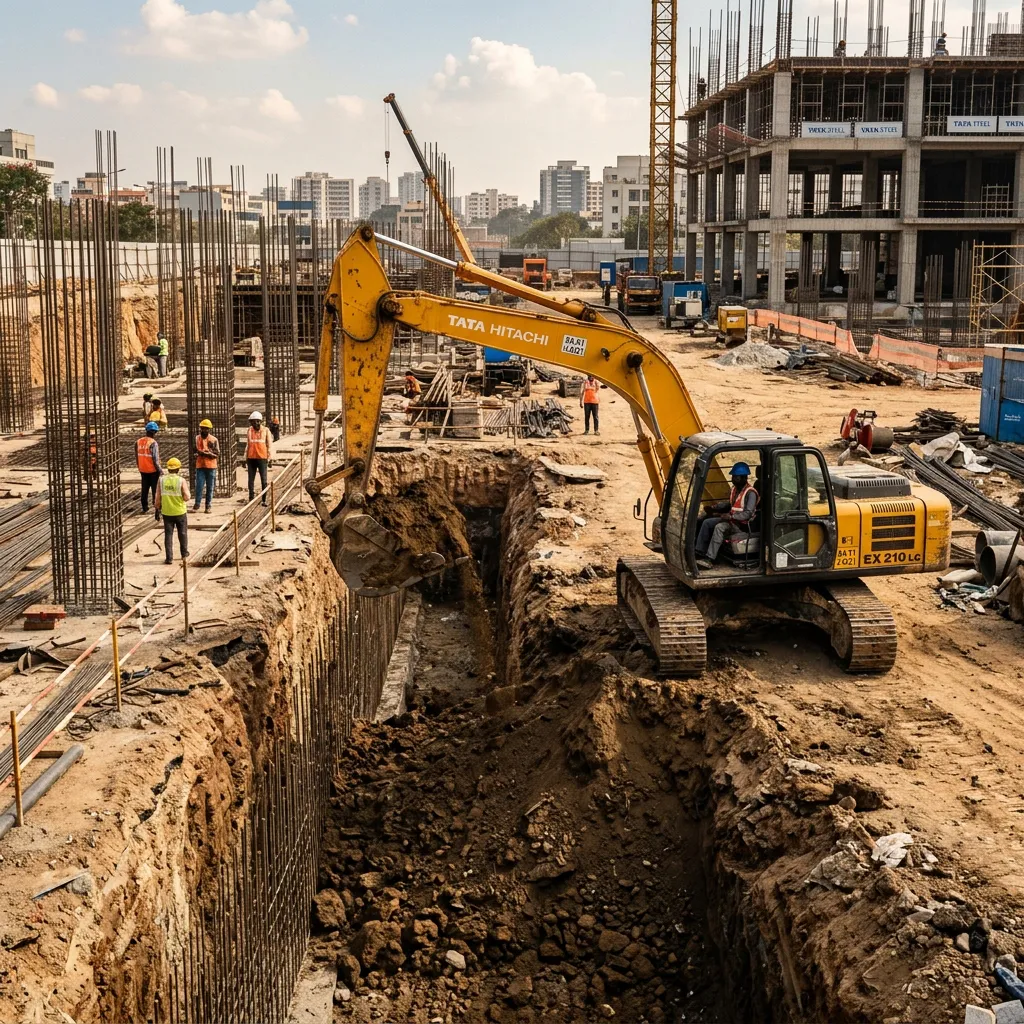
Excavation and trenching services in Coimbatore for industrial sites succeed or fail on sequencing: utility trenches must be opened, laid, and backfilled around live production shifts, loaded haul roads, and existing underground services that are rarely mapped accurately. A trench that closes a factory access road for even half a day translates directly into lost production, so our planning starts with the client's shift and dispatch schedule, not just the utility drawing. This piece covers how we run trenching on operating industrial plots around the Kuniamuthur, Sulur and Peelamedu industrial belts, from trench box selection through post-backfill compaction testing and safety audits on deeper cuts.
1 · Utility Trenching Sequencing Around Live Industrial Operations
On an operating factory or warehouse plot, we sequence trenching in short sections rather than opening a full run at once, closing and backfilling each 20-30 metre segment before moving to the next so that internal roads and loading bays are never blocked for more than a working shift. This section-by-section method costs slightly more in mobilisation time than a single continuous open trench, but it is the only approach that keeps a client's dispatch trucks moving during the work. We agree the sequencing plan with the client's plant manager before mobilising, mapping which internal roads must stay open on which days, and we schedule the noisiest and most disruptive trenching — typically the crossing points under access roads — for weekends or planned production downtime wherever the client can offer it.
Trench alignment is set out from the approved utility drawing but always cross-checked on the ground against visible manholes, valve chambers and cable markers before the first cut, since industrial plots that have been through several rounds of ad-hoc expansion frequently have services that were never updated on the master drawing. Where the alignment must cross an existing internal road, we plan for either a short closure with steel trench plates bridging the cut for vehicle movement, or a night-shift dig-and-backfill cycle completed before the first day shift begins. This kind of tight sequencing around an active site is closely related to the excavation discipline we describe in our piece on basement excavation for commercial buildings in Coimbatore, adapted here for linear utility runs instead of a single footprint.
2 · Trench Box Selection by Soil Classification (Type A/B/C)
We classify trench soil into Type A (cohesive, stable soils such as clay and clay loam with unconfined compressive strength above 1.5 kg/cm²), Type B (moderately stable soils including angular gravel and previously disturbed fill), and Type C (least stable — granular soils, submerged soil, or soil seeping water) before selecting the shoring system, following the same logic OSHA and Indian trenching safety practice apply to protective system selection. Coimbatore's red loam typically classifies as Type A to Type B when undisturbed, but a large share of industrial plots sit on previously filled or graded ground from earlier construction phases, which reclassifies the soil to Type B or C regardless of what the natural subgrade would suggest. We treat any trench on made-up or filled industrial ground as Type C by default unless site testing proves otherwise.
For Type C soil or any trench deeper than 1.2 metres, we deploy hydraulic or manual trench boxes sized to the trench width and depth, lowered in with an excavator rather than assembled inside an open cut. Trench box selection also accounts for the surcharge from stockpiled spoil, which we keep set back at least the trench depth from the edge as standard practice, and from any plant or vehicle loads operating near the excavation on a live industrial yard. Box specification, soil class, and surcharge calculation are recorded on our daily trench safety log for every industrial excavation, consistent with the deeper-trench safety approach in our piece on safety protocols for deep trenching.
"A trench that closes a factory access road for even half a day translates directly into lost production, so our planning starts with the client's shift and dispatch schedule, not just the utility drawing."
3 · Coordinating Multi-Utility Trenches (Water, Power, Sewer, Fibre)
Industrial plots frequently need water supply, power cabling, sewer or effluent lines, and fibre or data cabling laid within the same corridor, and running these as separate single-service trenches wastes both excavation cost and reinstatement area. Where clearances allow, we combine multiple services into a single common trench with vertical and horizontal separation maintained per the utility provider's minimum clearance norms — typically keeping power cabling at a different depth band from water and sewer lines, with sand cushioning and warning tape marking each service before backfill. This common-trenching approach cuts total excavation length on a multi-utility industrial layout significantly compared with laying each service independently.
Sequencing within a combined trench matters as much as the trench layout itself: we lay and test the deepest or most disruption-sensitive service first — usually gravity-flow sewer or effluent lines, which cannot tolerate re-excavation once backfilled — before laying pressure-fed water lines and finally the shallower power and fibre conduits. Each service is inspected and, where applicable, pressure-tested or continuity-tested before that section of trench is backfilled, since reopening a backfilled and compacted multi-utility trench to fix one buried service damages the compaction of everything laid alongside it.
4 · Managing Excavation Spoil and Backfill Compaction Standards
Spoil generated from industrial trenching is segregated at the point of excavation into reusable soil suitable for backfill and unsuitable material — organic topsoil, oversized stone, or debris from earlier fill — that must be trucked off-site. Reusable spoil is stockpiled adjacent to the trench in a manner that keeps haul roads and adjacent plant operations clear, and it's screened to remove stones larger than about 75mm before it goes back into the trench around pipes or cables, since oversized material backfilled directly against a buried service risks point-loading and long-term damage. Backfill is placed and compacted in layers not exceeding 150-200mm loose thickness, using plate compactors in confined trench widths where a roller cannot manoeuvre.
We target a minimum of 95% of the Proctor maximum dry density on backfill compaction under industrial hardstand or road crossings, verified through field density testing at representative points along the trench run rather than a single test for the whole length. Under-compacted trench backfill is one of the most common causes of settlement cracking in industrial floor slabs and road crossings months after handover, so we treat this compaction standard as non-negotiable regardless of how much schedule pressure exists to close and reopen a section quickly.
5 · Safety Audits on Trenches Deeper Than 1.5 Metres
Any trench on our sites deeper than 1.5 metres triggers a mandatory documented safety audit before workers enter, covering shoring or trench box condition, spoil setback distance, means of egress (a ladder or ramp within 7.5 metres of any worker in the trench), atmospheric conditions where the trench is near effluent or sewer lines, and barricading against vehicle and pedestrian traffic on a live industrial yard. This audit is repeated at the start of each shift and after any rainfall or nearby vibration event such as heavy vehicle movement or pile driving, since soil conditions in a trench can change materially within hours on an active site.
We operate this audit discipline under our ISO 45001:2018 occupational health and safety management certification, with a designated competent person responsible for trench inspection sign-off before any worker enters below 1.5 metres. On industrial sites specifically, the audit also checks proximity to existing live services — buried power cables or pressurised gas and water lines discovered mid-dig — since an industrial plot's undocumented legacy utilities are a materially higher risk than trenching on greenfield ground.
Operational Summary & Takeaways
Excavation and trenching for industrial projects in Coimbatore demands short-segment sequencing around live operations, soil-appropriate trench box selection, disciplined multi-utility coordination, verified backfill compaction, and mandatory safety audits on any cut beyond 1.5 metres. Sri Vari Constructions holds PWD Class-I licence TN/PWD/CBE/CIV/01/2019, First Class NHAI registration RC/2021/0871, and ISO 45001:2018 safety certification, and serves industrial clients across Coimbatore, Tiruppur, Erode, Salem, Pollachi, Karur, Namakkal, Dindigul and Sulur. For a trenching plan tailored to your plant's shift schedule, see our excavation services or get in touch through our contact page.