
Excavation Contractor in Karur: Basement Cuts and Foundation Digging
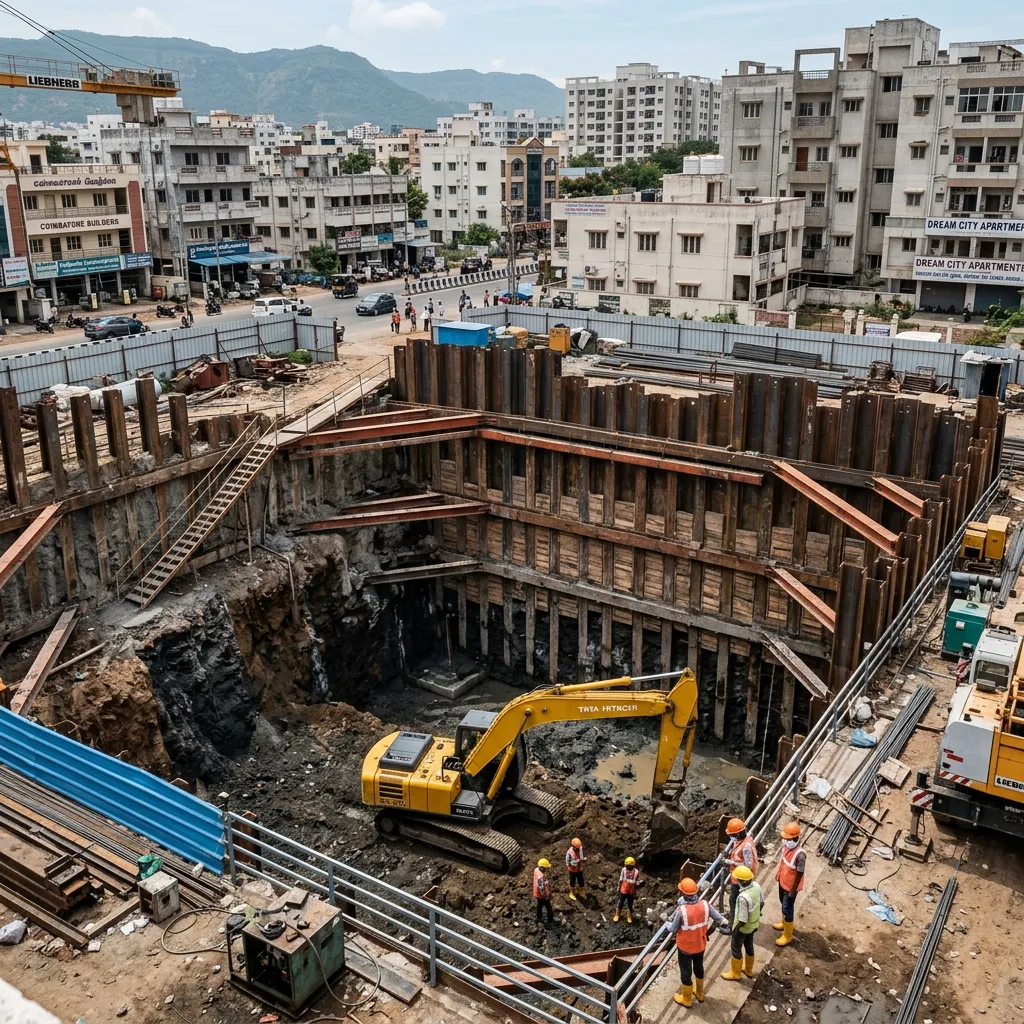
An excavation contractor in Karur has to plan around one dominant fact: the district's river-basin alluvial soils sit on a shallow water table for much of the year, which turns an ordinary basement cut into a dewatering and shoring exercise the moment it goes below two to three metres. This is different from excavation planning further inland in the Kongu belt, where groundwater is rarely the first constraint. This piece covers how we sequence a Karur excavation from soil investigation through handover, including where shoring and dewatering become mandatory rather than optional.
1 · Karur's River-Basin Alluvial Soil and Shallow Water Table Risk
Karur sits along the Cauvery river basin, and much of the town and its surrounding textile and dyeing units are built on alluvial soil deposits — fine-grained silty and sandy layers laid down by historic river flooding, with generally poor cohesion compared to the red loam found further from the riverbank. This soil type has a comparatively high permeability in its sandy layers, meaning groundwater moves through it readily, and the water table itself sits close to the surface for large parts of the year, rising further during and after the monsoon. Before any excavation deeper than about two metres, we commission a soil investigation specifically checking water table depth at the time of testing and seasonal variation records where available, since a dry pit dug in the summer can flood within hours once the same excavation is attempted during or just after monsoon season.
We also test grain-size distribution and cohesion parameters on Karur alluvial samples specifically, since standard assumptions calibrated to the loam soils common around Coimbatore don't transfer directly to this river-basin material. Low cohesion alluvial soil is also more prone to side-wall collapse during excavation than a cohesive clay, which is the direct reason shoring becomes standard practice here at shallower depths than it might elsewhere in our service area. We've written more broadly about handling this kind of surprise in our piece on unexpected groundwater during excavation.
2 · Shoring Systems for Deep Basement Cuts Near the Cauvery Belt
For basement cuts beyond roughly 2.5-3 metres in Karur's alluvial soil, we specify a shoring system rather than relying on a sloped, open-cut excavation, since low-cohesion saturated soil cannot reliably hold a stable slope angle at depth without significant lateral spread of the excavation footprint — often impractical on tighter urban and industrial plots near the river. Sheet piling, driven or vibrated into place around the excavation perimeter, is our standard approach for deeper cuts in this soil type, since it provides both lateral earth support and a partial groundwater cutoff, reducing the volume of water that needs to be pumped during dewatering. Where site access or vibration restrictions near existing structures rule out driven sheet piling, we use soldier pile and lagging systems instead, accepting the additional installation time for reduced ground disturbance.
Every shoring design is checked against the anticipated surcharge load from adjacent structures, stockpiled excavated material, and any crane or equipment operating near the excavation edge, since an under-designed shoring system that appears stable on day one can fail under an added surcharge introduced later in the construction sequence. We follow this same safety discipline on all deep trenching work generally, detailed further in our piece on safety protocols for deep trenching, adapted here specifically for Karur's higher groundwater risk.
"A dry pit dug in summer can flood within hours once the same excavation is attempted during or just after monsoon season."
3 · Rock Breaking and Bulk Removal Rates for Textile-Unit Foundations
While much of Karur's near-surface geology is soft alluvium, foundation excavation for heavier textile and processing unit structures sometimes encounters harder strata at greater depth, requiring rock breaking equipment rather than standard excavator bucket digging. We deploy hydraulic rock breakers mounted on excavators for this transition zone, sequencing the break-and-remove cycle to keep pace with the bulk excavation rate of the surrounding soft soil rather than letting a hard-rock pocket become a bottleneck that stalls the whole excavation crew. Bulk removal for larger textile-unit foundation footprints is handled with a coordinated fleet of excavators loading directly into tippers, with haul routes and dumping points confirmed before excavation begins to avoid trucks queuing on a congested industrial access road.
Where excavated alluvial soil is suitable for reuse as backfill once foundation and basement structures are complete, we stockpile it separately from any rock spoil or unsuitable material, reducing the volume that needs to be trucked off-site and reducing overall project material cost. This segregation decision is made at the excavation stage itself, since mixing reusable soil with rock spoil in a single stockpile makes later separation impractical.
4 · Dewatering Sequencing to Keep an Excavation Dry During Monsoon
Dewatering on a Karur excavation typically starts before bulk digging reaches the water table, using well-point systems or sump pumping depending on the soil's permeability and excavation depth, with pumps sized against the anticipated inflow rate calculated from soil permeability testing rather than installed reactively once water starts entering the pit. Sump pumping, drawing water to a low collection point within the excavation and pumping it out continuously, works adequately for shallower cuts with moderate inflow, while deeper cuts or highly permeable sandy layers often need a well-point system installed around the excavation perimeter to draw the water table down before excavation reaches that depth, keeping the working face genuinely dry rather than merely pumped.
During monsoon months, we run dewatering continuously rather than on a scheduled or reactive basis, since inflow rates in Karur's alluvial soil can increase sharply within hours of heavy rainfall upstream in the catchment, well before rain falls directly on the site itself. Pump redundancy — a backup pump on standby for every active dewatering point — is standard practice on our monsoon-season excavations here, since a single pump failure during a heavy inflow event can flood a partially completed foundation excavation within a short window.
5 · Handover Survey and As-Built Excavation Records
On completion, we conduct a survey confirming the excavation's final depth, base levels, and dimensions against the approved foundation drawings, along with a record of the shoring system's as-installed configuration where sheet piling or soldier piles remain in place as permanent works. This handover survey is what allows the client's structural engineer to confirm the excavation matches design assumptions before foundation concrete is poured, catching any discrepancy while it's still correctable rather than after the foundation is cast.
We also document the dewatering record — pump run-hours, observed inflow rates, and water table behavior during excavation — since this data has ongoing relevance to the client's basement waterproofing design and any future excavation on adjoining plots. This as-built documentation is compiled under the same ISO 9001:2015 quality system we apply across all civil works, ensuring a Karur excavation client receives the same standard of verified record-keeping as our larger PWD and NHAI contracts.
Operational Summary & Takeaways
Excavation in Karur demands early recognition of shallow water table risk in the district's alluvial soil, disciplined shoring for deeper cuts, continuous dewatering through monsoon months, and a verified handover survey before foundation work proceeds. Sri Vari Constructions holds PWD Class-I licence TN/PWD/CBE/CIV/01/2019 and ISO 45001:2018 safety certification, and serves Karur alongside Coimbatore, Tiruppur, Erode, Salem, Pollachi, Namakkal, Dindigul, the Nilgiris, Mettupalayam, Sulur and Udumalpet. For a soil investigation and excavation quote, see our excavation services or reach out through our contact page.