
Dealing with unexpected groundwater during excavation
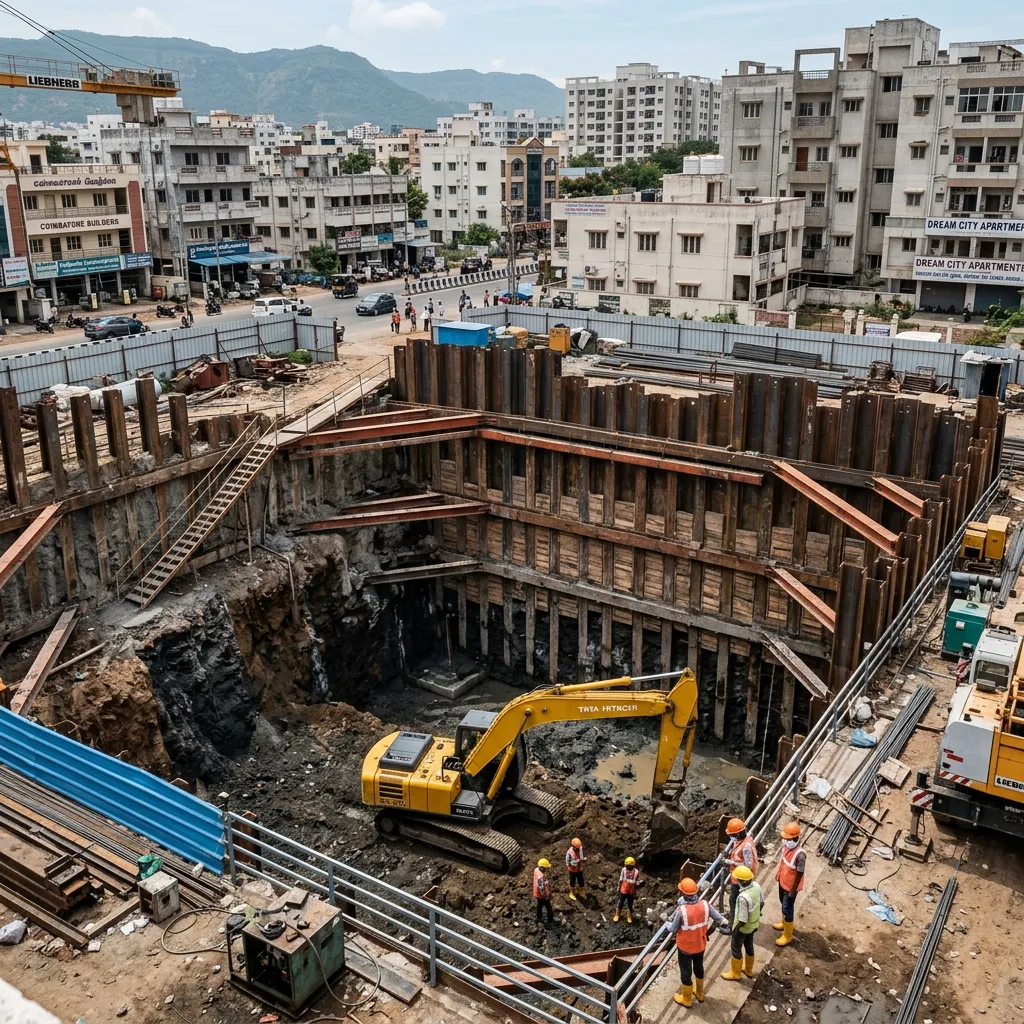
Water is the natural enemy of open excavations. When digging foundations in low-lying zones of Coimbatore, such as near the Noyyal river basin or Sulur, site engineers frequently strike unexpected perched water tables. If not managed immediately, rising groundwater can liquify trench bottoms, compromise soil bearing capacity, and halt operations.
1 · Wellpoint Dewatering & Submersible Pump Systems Installation
Implementing robust standards for wellpoint dewatering & submersible pump systems installation requires aligning our field crews with standardized geotechnical and engineering procedures.
Striking shallow groundwater during basement or deep trench excavation destabilizes soil walls and prevents concrete foundation placement. To dewater these zones, we deploy wellpoint dewatering systems. This involves driving a series of vertical wellpoints around the perimeter of the excavation, connected to a common horizontal suction manifold under vacuum. High-capacity vacuum pumps draw down the local water table, creating a dry zone for excavation. After reaching the design foundation depth, a lean concrete mud-slab (mud mat) is cast over the soil bed. This seals the foundation, prevents groundwater from carrying away cement paste, and provides a stable working platform for reinforcing steel placement and structural concrete pouring. We also monitor discharge water quality, passing it through filtration basins to remove silt before releasing it, preventing environmental contamination. The dewatering system is run continuously until the concrete foundation is cast and cured, ensuring structural stability and preventing foundation buoyancy issues.
Deploying and managing dewatering pump logistics is critical during heavy storm events. We maintain a fleet of diesel-powered self-priming centrifugal pumps and electric submersible pumps ranging from 5 HP to 25 HP. During emergency dewatering, pumps must operate continuously; we establish dedicated on-site fuel stations and deploy maintenance technicians on 12-hour shifts to monitor engine oil, clean intake strainers, and repair suction hoses. Water discharged from excavations often contains suspended silt and sand; to prevent local municipal drainage blockages, we pass the pumped water through temporary silt settlement basins before discharging it into natural channels. We also coordinate with local municipal authorities to ensure discharge paths have adequate capacity, avoiding flooding of adjacent areas. This systematic pump management prevents structural damage to open excavations and ensures safe working conditions during severe weather.
"Striking shallow groundwater during basement or deep trench excavation destabilizes soil walls and prevents concrete foundation placement."
2 · Slurry Cut-Off Walls & Lateral Trench Shoring Systems
Under our Coimbatore PWD quality guidelines, executing slurry cut-off walls & lateral trench shoring systems demands rigorous verification of all field metrics and material properties.
Excavations deeper than 1.5 meters present significant soil cave-in hazards, especially in the variable soil profiles of Coimbatore. To protect workers in deep trenches, Sri Vari Constructions enforces rigid shoring and protective system protocols. We utilize structural MS trench boxes, timber shoring, and sheet piling depending on soil classification (Type A, B, or C). Spoil piles of excavated earth are strictly placed at least 1.5 meters from the trench edge to prevent slides. Daily inspections are conducted by a designated safety officer to check for tension cracks, water seepage, or bulging walls. Safe access is maintained using heavy-duty aluminum ladders placed every 15 meters along the excavation, extending at least 1 meter above the surface to ensure secure egress. Workers are equipped with safety harnesses, helmets, and high-visibility jackets. We also conduct gas testing in deep trenches where organic matter might generate toxic gases, ensuring a safe working environment. These safety measures are supported by regular toolbox talks and emergency drills, ensuring that our field crew is prepared to handle any excavation hazard proactively.
Soil chemistry plays a vital role in concrete foundation durability. High levels of soluble sulfates and chlorides in groundwater and soil can cause severe concrete deterioration. Sulfates react with hydrated calcium aluminate phases in cement, forming ettringite, which expands and cracks the concrete (sulfate attack). Chlorides penetrate concrete and depassivate reinforcing steel, initiating rapid rebar corrosion. In high-risk zones, such as agricultural fields with heavy fertilizer runoff or industrial areas near Coimbatore, we use Portland Pozzolana Cement (PPC) or Sulfate-Resisting Cement (SRC). We also increase the concrete cover over reinforcing steel and apply waterproofing bituminous coatings to foundation walls to block chemical ingress. We perform chemical testing of soil and groundwater samples prior to construction, determining sulfate concentration (SO3) and chloride content to select the appropriate cement type and concrete mix design, ensuring long-term structural durability under aggressive environmental conditions.
3 · Mud-Mat Lean Concrete Bed Seals & Concrete Hydration Care
To achieve maximum structural stability during the mud-mat lean concrete bed seals & concrete hydration care phase, we enforce strict compliance controls across our regional sites.
Heavy construction machinery uptime is critical to meeting tight project timelines. Our fleet, including excavators, motor graders, soil compactors, and transit mixers, undergoes rigorous preventive maintenance. Soil and dust from excavation sites accelerate wear on track chains, pins, and rollers; we enforce daily undercarriage washdowns. Hydraulic systems are checked for pressure drops and water ingress, which can damage hydraulic pumps. Engine oil, filters, and air intake systems are serviced at designated running hour intervals (typically every 250 hours). By maintaining comprehensive service logs and stocking critical spares at our Coimbatore yard, we minimize on-site breakdowns and maintain high operational efficiency. We also train our operators to perform daily pre-start checks, monitoring coolant levels, hydraulic hoses, and warning indicators. This proactive maintenance culture ensures machinery availability and enhances site safety by preventing equipment failures during critical operations.
Borelog analysis is critical for selecting and designing building and bridge foundations. A standard borelog documents soil strata types, groundwater levels, and Standard Penetration Test (SPT) N-values at regular depth increments. SPT N-values represent the blow count required to drive a split-spoon sampler 300mm into the soil. Higher N-values indicate denser sand or stiffer clay, translating to higher Safe Bearing Capacity (SBC). In the clayey and silty soils of Coimbatore, low N-values (below 10) near the surface warn of soft soils prone to consolidation and settlement. Our engineers analyze these profiles to determine if shallow footings are safe or if we must over-excavate and replace the soil with compacted gravel, utilize raft foundations, or drive concrete piles to reach deeper, stable bearing strata. We also cross-reference borelog data with laboratory tests on undisturbed soil samples, such as direct shear and consolidation tests, to refine our foundation designs and predict settlement characteristics with high accuracy, ensuring structural safety under all design loads.
| Quality Verification Step | Audit Standard | Tolerance Benchmark / Compliance Target |
|---|---|---|
| Material Receipt Inspections | IS 383 Sieve Analysis | Zero organic contaminations; moisture grading within curves |
| Field Density Compactions | IS 2720 Part 28 Sand replacement | Minimum 98% field dry density versus lab standards |
| Concrete Cube Compressive Checks | IS 516 Compressive strength | Target 28-day crushing load exceeded on all cast cubes |
4 · Concrete Compressive Strength Cube Testing & Slump Controls
A major element of managing concrete compressive strength cube testing & slump controls successfully lies in coordinating logistics, material testing, and machinery runtime.
Meticulous topographic surveying is the first step in successful site development and grading. Our engineering teams deploy Leica Total Stations and RTK (Real-Time Kinematic) GPS receivers to map site contours with millimeter accuracy. A high-density grid of elevation points is established, referencing permanent benchmarks linked to the national height datum. This digital spatial data is imported into CAD software to generate 3D digital terrain models (DTM) and calculate earthworks balances. Balancing cut-and-fill volumes minimizes the need to import expensive fill gravel or pay for hauling surplus soil off-site. Accurate stakeouts ensure that structural foundations, drainage channels, and roadway subgrades are excavated to the precise design coordinates and slopes, eliminating manual alignment errors and ensuring smooth surface drainage. During construction, we perform regular check-surveys to verify excavation depths and structural alignments, preventing deviations before concrete is poured. This digital workflow streamlines the client approval process and provides a precise as-built record for future site maintenance and expansion.
Achieving specified concrete compressive strength (M25, M30, or M40 grades) requires strict control of the water-cement ratio, aggregate gradation, and curing conditions. We utilize digital weight-batching plants to measure cement, fine aggregate (M-sand), coarse aggregate (20mm and 12mm blue metal), and water by mass. Fine aggregate gradation is checked using sieve analysis (IS 383) to ensure a stable grading curve. The water-cement ratio is kept at the minimum necessary for hydration and workability, supplemented by superplasticizing admixtures to improve concrete flow without adding excess water. Concrete workability is tested using the slump cone on-site before pouring. During the pour, representative concrete cubes are cast, cured in specialized water tanks on-site, and tested at 7 and 28 days using a calibrated compression testing machine to verify compliance with PWD/NHAI standards. We also monitor concrete temperature during placing, especially in hot weather, to prevent thermal cracking. Proper compaction using needle vibrators is enforced to eliminate air voids and ensure a dense concrete matrix, maximizing durability and structural load capacity.
5 · Soil Chemistry Audits & Sulfate Resistance Engineering
Ultimately, our site supervisors inspect every phase of soil chemistry audits & sulfate resistance engineering to prevent structural settling and secure client sign-off.
Maintaining comprehensive quality records is a core requirement for PWD and NHAI project compliance. Our project offices maintain registers for material receipts, concrete pours, compression test results, and level checks. Material delivery tickets, mill certificates, and third-party laboratory reports are filed systematically. These records are reviewed during inspections by departmental engineers, verifying that all materials and construction processes meet project specifications before billing approvals are granted. We also compile as-built surveys, quality logs, and contract documentation, preparing detailed project handbooks for municipal and state agencies. This rigorous drafting procedure supports our Class-I standing, ensuring quality compliance across all public works.
PWD projects are subject to strict quality control audits by departmental engineers and third-party testing agencies. Quality audits involve inspecting raw material test certificates, reviewing batch plant logs, and conducting in-situ tests. We maintain a mobile testing laboratory equipped to perform grain-size distribution, liquid limit, plastic limit, and compaction testing directly on-site. All test results are logged in a quality register signed by our QC engineer and the department representative. Maintaining this detailed quality record is a prerequisite for billing approvals, demonstrating our commitment to delivering infrastructure that meets PWD specifications. We also coordinate third-party inspections with independent testing labs, validating our field and laboratory test results. This quality assurance framework ensures that all construction works meet contractual quality standards, facilitating timely payment approvals and project sign-offs.
6 · Continuous Deep Well Pumping & High-Head Centrifugal Systems
Furthermore, daily reporting and quality logging are mandated to maintain complete project visibility and contract compliance.
Striking shallow groundwater during basement or deep trench excavation destabilizes soil walls and prevents concrete foundation placement. To dewater these zones, we deploy wellpoint dewatering systems. This involves driving a series of vertical wellpoints around the perimeter of the excavation, connected to a common horizontal suction manifold under vacuum. High-capacity vacuum pumps draw down the local water table, creating a dry zone for excavation. After reaching the design foundation depth, a lean concrete mud-slab (mud mat) is cast over the soil bed. This seals the foundation, prevents groundwater from carrying away cement paste, and provides a stable working platform for reinforcing steel placement and structural concrete pouring. We also monitor discharge water quality, passing it through filtration basins to remove silt before releasing it, preventing environmental contamination. The dewatering system is run continuously until the concrete foundation is cast and cured, ensuring structural stability and preventing foundation buoyancy issues.
Deploying and managing dewatering pump logistics is critical during heavy storm events. We maintain a fleet of diesel-powered self-priming centrifugal pumps and electric submersible pumps ranging from 5 HP to 25 HP. During emergency dewatering, pumps must operate continuously; we establish dedicated on-site fuel stations and deploy maintenance technicians on 12-hour shifts to monitor engine oil, clean intake strainers, and repair suction hoses. Water discharged from excavations often contains suspended silt and sand; to prevent local municipal drainage blockages, we pass the pumped water through temporary silt settlement basins before discharging it into natural channels. We also coordinate with local municipal authorities to ensure discharge paths have adequate capacity, avoiding flooding of adjacent areas. This systematic pump management prevents structural damage to open excavations and ensures safe working conditions during severe weather.
Operational Summary & Takeaways
This concludes our comprehensive analysis on dealing with unexpected groundwater during excavation. At Sri Vari Constructions, we understand that delivering high-performance infrastructure requires a combination of advanced engineering, rigorous quality assurance, and deep local geological knowledge. As a licensed Class-I Civil Contractor serving Coimbatore, Tiruppur, Erode, and the wider Kongu region, we adhere strictly to the latest Ministry of Road Transport and Highways (MoRTH) standards, Tamil Nadu Public Works Department (PWD) specifications, and NHAI quality guidelines. By maintaining a privately owned fleet of over 85 machinery units—including hydraulic excavators, motor graders, and vibratory compactors—and employing experienced site engineers, we ensure that every project we undertake is built to last. Our commitment to daily reporting, strict safety protocols, and robust engineering standards has established us as a trusted partner for public works and private industrial site developments across Tamil Nadu.