
Building Demolition Contractor in Pollachi: Process, Permits and Timelines
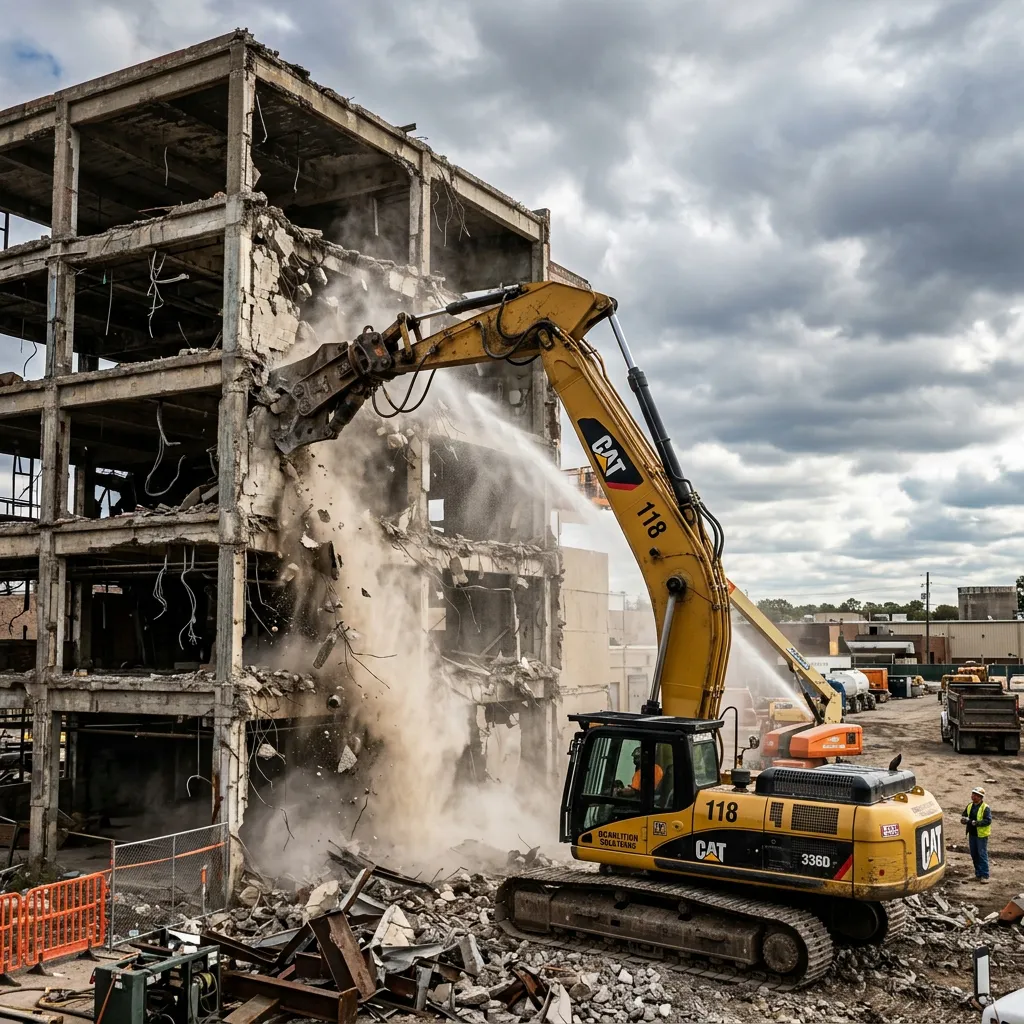
A building demolition contractor in Pollachi has to secure a local body NOC and a TNPCB consent for construction and demolition (C&D) waste before a single wall comes down — skipping either step can halt a project mid-way through mobilisation. Pollachi's dense town-centre layouts, tight plot boundaries, and mix of old load-bearing masonry structures alongside newer RCC-frame buildings also mean the demolition method has to be chosen structure by structure, not applied uniformly. This piece walks through our actual process for a Pollachi demolition, from permits through final debris clearance.
1 · Local Body NOC and TNPCB C&D Waste Consent Before Demolition
Before mobilising equipment, we secure a demolition permit or No Objection Certificate from the Pollachi Municipality (or the relevant town panchayat for outlying plots), which requires submission of the structure's ownership documents, an undertaking on utility disconnection, and in many cases a structural stability report where the building is adjacent to a shared wall or a public road. In parallel, we apply for Construction and Demolition Waste Management consent under the Tamil Nadu Pollution Control Board's C&D Waste Rules, which govern how debris must be segregated, transported, and disposed of rather than dumped informally. Both approvals typically need to be in hand before demolition equipment is mobilised to site, and we build this lead time into every Pollachi project schedule rather than treating it as a formality that can run parallel to early works.
We also coordinate utility disconnection directly with TANGEDCO for electrical supply and the local water authority for plumbing connections before any structural work begins, since an undisconnected live service is both a safety hazard and frequently a condition the local body checks before issuing the NOC. Where the structure sits on a narrow Pollachi lane with limited vehicle access, we note access constraints in our permit application itself, since it affects the debris removal vehicle size and schedule the local body will expect us to follow.
2 · Structural Assessment: RCC Frame vs Load-Bearing Masonry Tear-Downs
Pollachi's building stock includes a substantial share of older load-bearing masonry structures — brick or stone walls carrying the full roof and floor load directly — alongside newer RCC (reinforced cement concrete) frame buildings where columns and beams carry the load and walls are simply infill. These two structural types demolish very differently. Load-bearing masonry can shift and collapse unpredictably once a section of wall is removed, since the load path through the structure changes with every removed element, so we sequence masonry demolition top-down in controlled lifts rather than undermining a lower wall while upper masonry still bears on it. RCC frame buildings, by contrast, allow more predictable sequencing since column and beam locations are known from the structural layout, but require careful attention to reinforcement continuity — cutting a column before its connected beams are relieved of load risks a sudden, uncontrolled section collapse.
We commission a structural walk-through before quoting any Pollachi demolition, checking for visible distress, prior unauthorized modifications (a common finding in older commercial buildings that have been informally extended over decades), and shared-wall conditions with neighbouring plots. This assessment determines whether the project needs a licensed structural engineer's sign-off before work begins, which is standard practice for any building over two storeys or with a shared party wall under our internal ISO 45001:2018 safety protocol.
3 · Hydraulic Shear and Long-Reach Excavator Sequencing on Site
For RCC structures, we deploy long-reach excavators fitted with hydraulic shears or pulverisers, working from the top floor downward in a controlled, layer-by-layer sequence that keeps the machine's working platform on stable, already-cleared ground rather than on partially demolished upper floors. Hydraulic shears cut through reinforcement bar and concrete cleanly, generating far less dust and vibration than uncontrolled mechanical breaking, which matters directly in Pollachi's dense layouts where structures often sit within a few metres of occupied neighbouring buildings. Where access constraints on a narrow lane rule out a long-reach excavator, we fall back to a combination of smaller excavators and controlled manual breaking for the upper sections, accepting a longer timeline in exchange for a machine footprint that fits the site.
Sequencing is planned in advance as a written method statement, identifying which structural elements come down in which order, where debris will be temporarily stockpiled on-site before removal, and how the excavator will reposition as the structure's footprint shrinks. We brief this sequence to the full crew each morning during multi-day demolitions, since a Pollachi site's confined working area leaves very little margin for improvised changes to machine positioning once work is underway.
"Load-bearing masonry can shift and collapse unpredictably once a section of wall is removed, so we sequence demolition top-down in controlled lifts rather than undermining a lower wall while upper masonry still bears on it."
4 · Dust Suppression and Neighbour Intimation in Dense Pollachi Layouts
Given how close Pollachi's town-centre plots typically sit to neighbouring residences and shops, we run continuous water spraying on demolition debris and active breaking points throughout the working day, both to suppress airborne dust and to reduce nuisance to adjoining occupants. Perimeter screening — typically shade net or tarpaulin fencing around the site boundary — is installed before demolition begins, both to contain flying debris fragments and to give the site a visible, controlled boundary that reduces pedestrian and vehicle traffic risk on narrow lanes. Site working hours are also scheduled to avoid the noisiest breaking activity during early morning or late evening hours where the site borders residential use.
Before mobilisation, we notify adjoining property owners and occupants directly of the demolition schedule, expected duration, and a site contact number, which reduces disputes and complaints during the work and is often expected practice by the local body reviewing the NOC application. This intimation step is a small operational cost that consistently saves time compared to responding to complaints or work stoppages triggered by an unannounced demolition start.
5 · Scrap Salvage, Segregation and Licensed Debris Disposal
Demolition debris is segregated on-site into distinct streams — reinforcement steel and structural metal scrap, timber, brick and masonry rubble, and mixed C&D waste — since segregated material both salvages recoverable value and complies with TNPCB's C&D waste handling rules, which increasingly discourage mixed dumping. Steel scrap is sold directly to registered scrap dealers, recovering value that offsets part of the demolition cost, while masonry rubble is either crushed on-site for reuse as sub-base fill on the same project (where the client is redeveloping the plot) or transported to a licensed C&D waste processing facility rather than an informal dump site.
We maintain disposal records — weighbridge slips, transporter details, and the receiving facility's licence reference — for every load leaving a Pollachi demolition site, since these records are what demonstrate compliance if the local body or TNPCB requests documentation after the fact. This record-keeping discipline mirrors the same quality documentation standard our ISO 9001:2015 certification requires across all our civil works, applied here to demolition and waste handling rather than new construction.
Operational Summary & Takeaways
Demolition in Pollachi's dense layouts demands permit discipline, a structure-specific tear-down method, tight dust and neighbour management, and licensed, documented debris disposal from start to finish. Sri Vari Constructions holds PWD Class-I licence TN/PWD/CBE/CIV/01/2019 and ISO 45001:2018 safety certification, and serves Pollachi alongside Coimbatore, Tiruppur, Erode, Salem, Karur, Namakkal, Dindigul, the Nilgiris, Mettupalayam, Sulur and Udumalpet. For a site assessment and permit-inclusive demolition quote, see our building demolition services or reach out through our contact page.