
PWD Road Contractor in Tiruppur: What to Expect on a State Road Package
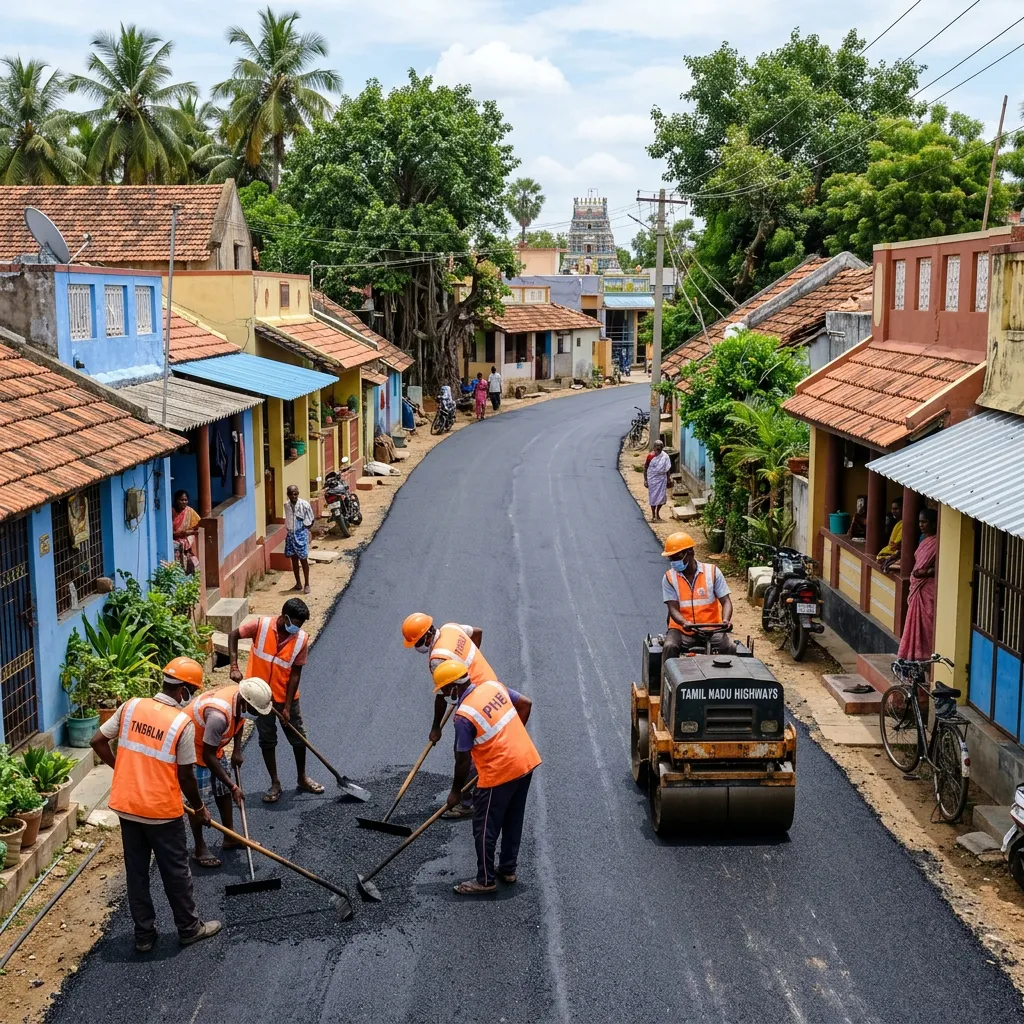
A PWD road contractor in Tiruppur has to design and build for a traffic mix most district roads elsewhere in Tamil Nadu never see: fully loaded yarn and fabric trucks moving continuously between knitwear units, dye houses, and warehousing clusters, day and night. That traffic profile changes pavement thickness, drainage priorities, and effluent-crossing planning compared to a purely agricultural district road. This piece walks through what we actually do, phase by phase, on a Tiruppur state road package, from soil investigation through final PWD handover, and what a client or department engineer should expect to see at each stage.
1 · Tiruppur's Soil and Traffic Load Profile for Pavement Design
Tiruppur district sits on a mix of red loam and pockets of black cotton soil, particularly toward the Avinashi and Palladam corridors, with subgrade CBR values that swing from a workable 6-7% in loam sections down to 2-3% where expansive clay dominates. Before finalising a pavement design we commission a soil investigation at intervals along the alignment, testing plasticity index, free swell index, and CBR per IS 2720, because a single blanket design across a heterogeneous alignment either over-specifies the loam stretches or under-builds the clay stretches. Traffic surveys are equally central: knitwear and textile haulage runs a high proportion of two- and three-axle loaded trucks around the clock, which we classify into Commercial Vehicles Per Day (CVPD) and convert to Million Standard Axles (msa) over the design life per IRC:37 guidelines.
Where a road serves multiple dyeing or processing units directly, we've seen actual axle loads run above the design assumptions used on comparable rural roads elsewhere in the Kongu belt, which is why we push for a design traffic category one notch higher than a generic rural classification would suggest. Under-designing here shows up within two to three monsoon cycles as rutting and edge failure under the concentrated heavy-vehicle turning movements outside factory gates. Getting the subgrade CBR and design traffic category right at this stage is what determines every layer thickness that follows, so we treat it as non-negotiable before submitting any layer design for departmental approval.
2 · Schedule of Rates and Tender Eligibility for State Road Packages
Tamil Nadu PWD publishes a district-wise Schedule of Rates (SoR) annually, and Tiruppur packages are tendered against the current SoR with contractors bidding a percentage above or below the base rate. Eligibility for a state road package typically requires a valid PWD Class-I registration (we hold TN/PWD/CBE/CIV/01/2019), demonstrated turnover and bid capacity for the package value, an Earnest Money Deposit, and a technical bid documenting owned plant and equipment relevant to road works — pavers, rollers, hot-mix plants and haulage. Departments increasingly weight technical bids toward contractors who can show owned machinery rather than rented, since equipment availability is one of the more common causes of schedule slippage on live packages.
Financial bids are evaluated alongside the technical score, and the SoR itself needs local adjustment: published base rates assume standard haul distances and material costs, but Tiruppur's tight urban and semi-urban road network often means shorter haul but more traffic-management complexity around operating factories, which we factor into our internal cost model before quoting a percentage against the SoR. We also verify that our bid complies with current labour cess and GST treatment before submission, since a technically compliant but financially miscalculated bid can be disqualified or, worse, become unprofitable mid-contract.
3 · Subgrade-to-BC Layer Sequencing on a Textile-Belt Access Road
A typical Tiruppur state road package follows a standard flexible pavement build-up but with adjusted layer thicknesses where soil testing indicates lower CBR: prepared subgrade compacted to MoRTH Clause 305 targets, followed by Granular Sub-Base (GSB) per IS 2720 grading requirements, a Wet Mix Macadam (WMM) base course compacted in layers not exceeding 200mm loose thickness, a prime coat applied to the WMM surface before the Dense Bituminous Macadam (DBM) binder course, and finally a Bituminous Concrete (BC) wearing course laid over a tack coat. Each layer is compacted to a specified density before the next is placed, and we do not proceed to bituminous layers until GSB and WMM density checks clear MoRTH thresholds — skipping this sequence to save time is the single most common cause of premature rutting on textile-belt roads carrying heavy, repetitive axle loads.
Where the alignment crosses low-lying stretches near processing units, we sometimes specify a stabilised subgrade using lime or cement treatment rather than importing additional granular fill, since Tiruppur's clay pockets respond well to chemical stabilisation and it reduces haul traffic through congested factory access roads during construction. Bitumen grade selection — typically VG-30 for this climate zone — and mix temperature control during DBM and BC laying are monitored continuously, since Tiruppur's daytime temperatures through summer months push binder viscosity outside tolerance if paving crews aren't watching mix and rolling temperatures closely.
"Skipping the compaction sequence to save time is the single most common cause of premature rutting on textile-belt roads carrying heavy, repetitive axle loads."
4 · Handling Industrial Effluent Drainage Crossings During Construction
Tiruppur's dyeing and bleaching units operate under Tamil Nadu Pollution Control Board (TNPCB) consent conditions that frequently include Zero Liquid Discharge (ZLD) infrastructure and dedicated effluent conveyance pipelines that run parallel to, or cross beneath, road alignments. Before excavation begins near any known processing cluster, we coordinate with TNPCB records and the local body to map existing effluent lines, since striking an active ETP conveyance pipe mid-excavation creates both an environmental incident and a construction delay that can halt work pending remediation. Where a road crossing is unavoidable, we install a sleeved crossing or a dedicated culvert to carry the effluent line, sized and positioned to departmental drainage standards rather than improvised on-site.
Surface drainage design on these roads also has to account for occasional wash-off risk near industrial clusters, so side drains are lined with stone masonry or precast concrete sections sized generously beyond the minimum MoRTH standard in stretches adjoining processing units, reducing the chance of contaminated runoff pooling against the road shoulder. We document every effluent crossing we handle with as-built drawings handed to both the department and, where relevant, the local textile unit, since that record becomes essential if future road widening or utility work needs to locate the same line again.
5 · Measurement, Billing and Handover on a PWD Road Contract
Billing on a PWD road package runs against a Measurement Book (MB) jointly recorded by our site engineer and the departmental Junior Engineer at each stage — earthwork volumes, GSB and WMM thickness checks, and bituminous layer quantities are all measured and entered before a Running Account (RA) bill is submitted. Each RA bill is supported by material test certificates and compaction density reports, since PWD will not clear payment on a layer that lacks documented quality compliance. We maintain our own parallel measurement records specifically so any discrepancy between our figures and the department's MB can be resolved quickly rather than stalling the billing cycle.
On completion, the road passes through a joint final inspection, followed by a Defect Liability Period (DLP) — typically 12 months for bituminous roads — during which we remain responsible for rectifying any premature distress at our own cost before the final bill and security deposit are released. Handover documentation includes as-built drawings, the complete quality register, and test certificates compiled across the contract, which is the same documentation standard our ISO 9001:2015 quality system requires internally regardless of whether a given client asks for it.
Operational Summary & Takeaways
A PWD road package in Tiruppur demands pavement design tuned to genuinely heavy, continuous textile-haulage traffic, careful coordination around industrial effluent infrastructure, and disciplined layer-by-layer compaction sign-off before billing. Sri Vari Constructions holds PWD Class-I licence TN/PWD/CBE/CIV/01/2019 and serves Tiruppur alongside Coimbatore, Erode, Salem, Pollachi, Karur, Namakkal, Dindigul, the Nilgiris, Mettupalayam, Sulur and Udumalpet with an owned fleet suited to full road-package mobilisation. For a site visit or package discussion on an upcoming Tiruppur road contract, get in touch through our contact page.