Road Marking & Signage Contractor in Coimbatore
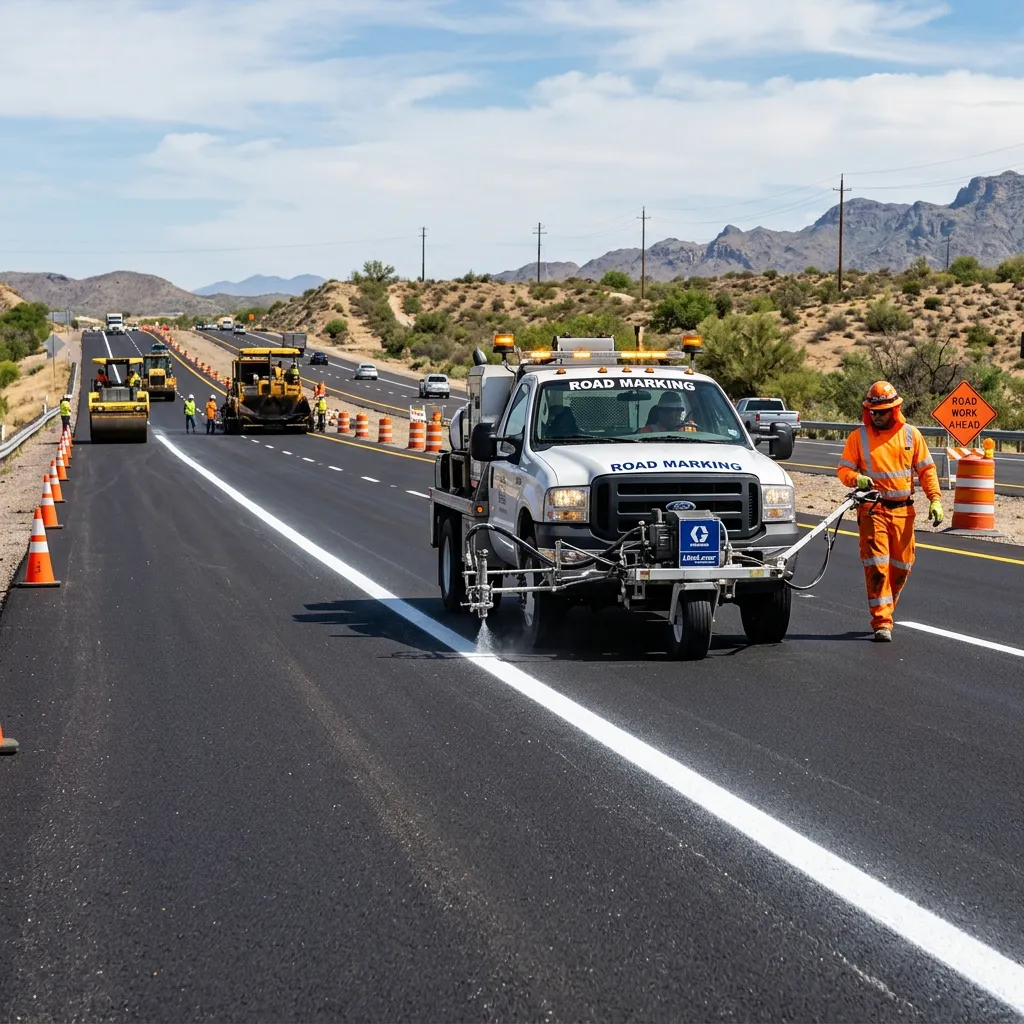
A road marking and signage contractor in Coimbatore has to choose between thermoplastic paint and cold-applied paint on almost every job, because the two materials trade off cost against durability in ways that matter for high-traffic corridors. Thermoplastic lasts several times longer than cold paint under heavy wheel traffic but costs more upfront and needs specific application temperature control. We run both systems out of our Kuniamuthur yard depending on the road class, traffic volume, and budget the client is working with, from municipal ward roads to NHAI-graded highway stretches.
1 · Thermoplastic Paint vs Cold Paint: Durability Trade-Offs
Hot-applied thermoplastic road marking material is heated to around 180-200°C in a preheater kettle and extruded or sprayed onto the pavement at a thickness of 1.5-3mm, where it fuses into the bitumen surface as it cools. This bonding gives it a service life of roughly 2-4 years on moderate-traffic roads and noticeably longer on lower-volume stretches, resisting abrasion from tyre wear far better than any cold-applied system. Cold paint, typically a chlorinated rubber or acrylic solvent-based coating applied at ambient temperature by brush, roller, or airless spray at 200-300 microns wet film thickness, dries faster and needs no heating equipment, but wears down under heavy traffic within 6-12 months and needs more frequent refreshing.
We recommend thermoplastic for arterial roads, NHAI stretches, and any corridor carrying more than a few thousand vehicles a day, since the higher material cost is offset by fewer repaint cycles and less traffic disruption over the marking's life. Cold paint remains the practical choice for low-traffic internal roads, temporary diversions, and situations where a preheater kettle can't be mobilised economically for a short stretch. Glass beads are dropped into both systems while the material is still wet, at roughly 250-450 grams per square metre depending on the specification, to provide the retroreflectivity that makes markings visible under headlight beam at night — a detail that's often the difference between a marking job that passes inspection and one that doesn't.
2 · IRC Standards for Lane Markings, Zebra Crossings and Chevrons
We set out lane markings, edge lines, and centre lines to IRC:35 dimensions — a standard 100-150mm marking width for lane and edge lines on two-lane carriageways, with broken centre-line segments typically run at a 3-metre paint to 4.5-metre gap ratio on undivided roads, tightening to a shorter cycle at approach to junctions and overtaking-restricted zones. Zebra crossings follow IRC guidance on stripe width and spacing, usually 400-600mm wide white bars with roughly equal gaps, oriented parallel to the direction of vehicle travel and sized to the crossing's pedestrian volume. Stop lines and give-way triangles at junctions get a solid 200-300mm marking set back from the crossing as specified in the junction's traffic control drawing.
Chevron and hazard markings on curves, medians, and lane-drop approaches follow IRC:67 for cautionary and mandatory sign placement, paired with painted chevron arrays angled to indicate the direction of a sharp bend well ahead of the curve itself, giving drivers enough sight distance to react. We also mark rumble strips and edge treatments on rural stretches — a detail that ties directly into how we approach road construction more broadly, since markings are only as effective as the pavement geometry and camber underneath them. Getting the layout wrong on a curve isn't a cosmetic error; it's a safety defect that shows up in accident data within months.
3 · Retroreflective Sign Fabrication and Mounting Standards
Cautionary, mandatory, and informatory signboards are fabricated on aluminium composite or GI sheet substrates faced with retroreflective sheeting, typically Engineering Grade or High Intensity Grade depending on the road's traffic speed and the sign's importance — a High Intensity Grade sheet reflects considerably more light back to a driver's headlights at distance than Engineering Grade, which matters most on high-speed rural and highway stretches where reaction time is limited. Sign panel sizes, letter heights, and colour combinations follow IRC:67 dimensions, scaled up for higher design speeds so that a driver approaching at 80-100 km/h has adequate legibility distance to read and react to the message.
Mounting height and lateral clearance from the carriageway edge are set to keep signs visible without becoming a roadside hazard themselves — generally a sign's bottom edge sits at a minimum clearance above ground level on rural stretches, higher again where pedestrian or cattle movement is common, with the post foundation cast in concrete to resist wind loading and vehicle impact glancing blows. We fabricate and install both new signage runs and replacement programs where existing boards have faded past their reflective service life, which typically shows up as a visibly duller sign under headlight testing well before the substrate itself fails.
"A marking layout that's wrong on a curve isn't a cosmetic error; it's a safety defect that shows up in accident data within months."
4 · Night-Shift Marking Operations to Minimise Traffic Disruption
Marking work on live carriageways in Coimbatore city and on busy NHAI stretches is scheduled for night hours, usually starting after 10 PM once peak traffic has cleared, specifically because thermoplastic and paint both need a closed lane and a curing window before traffic can safely run over fresh markings. We set up advance warning signage, cones, and barricades well ahead of the active work zone, staff a flagman at each end of the closure, and run a mobile preheater kettle or paint unit that moves progressively along the stretch rather than closing an entire corridor at once.
Thermoplastic cools and hardens within minutes of application, so traffic can typically resume over a marked section faster than with cold paint, which needs a longer ambient drying window before it's fully traffic-ready. We coordinate closure timing with the local traffic police and, on NHAI stretches, with the project authority's traffic management plan, since an unplanned lane closure on a highway carries its own safety risk that has to be managed as carefully as the marking work itself. High-visibility PPE for the crew is non-negotiable on every night shift, given the reduced visibility and proximity to moving traffic.
5 · Post-Monsoon Re-Marking Cycles on High-Traffic Corridors
The northeast monsoon takes a visible toll on road markings across the Kongu region — standing water, silt wash, and the abrasive grit that settles onto the carriageway during heavy rain accelerate wear on both thermoplastic and cold paint, so most of our re-marking contracts are scheduled to start once the wet season clears, typically from late November through December. We inspect existing markings for retroreflectivity loss using a handheld retroreflectometer where the contract calls for it, comparing readings against the minimum threshold in the specification rather than relying on a visual check alone, since a marking can look intact in daylight while having lost most of its night-time reflectivity.
High-traffic corridors — NHAI stretches, PWD state highways, and busy municipal arterials — get prioritised in the re-marking schedule over low-volume roads, since these are the stretches where worn markings create the most immediate safety risk. We also use the post-monsoon window to correct any markings that were laid out incorrectly in a previous cycle, adjusting lane widths or chevron placement where the road geometry or traffic pattern has changed since the last marking job. This is one of the smaller line items in a road maintenance budget but one of the most cost-effective for the safety return it delivers.
Operational Summary & Takeaways
Road marking and signage work in Coimbatore depends on matching the right material, thermoplastic or cold paint, to the road's traffic volume, following IRC dimensional standards for lanes, crossings, and chevrons, and scheduling both application and re-marking cycles around monsoon wear and traffic disruption. As a licensed PWD Class-I and First Class NHAI road contractor active across Coimbatore, Tiruppur, Erode, Salem, and Pollachi, we run marking and signage work as a core part of our road construction capability, alongside pavement work covered in our notes on how GSB, WMM, DBM and BC pavement layers come together. Reach out through our contact page to scope a marking or signage program for your stretch.