
Site development challenges in rocky terrain
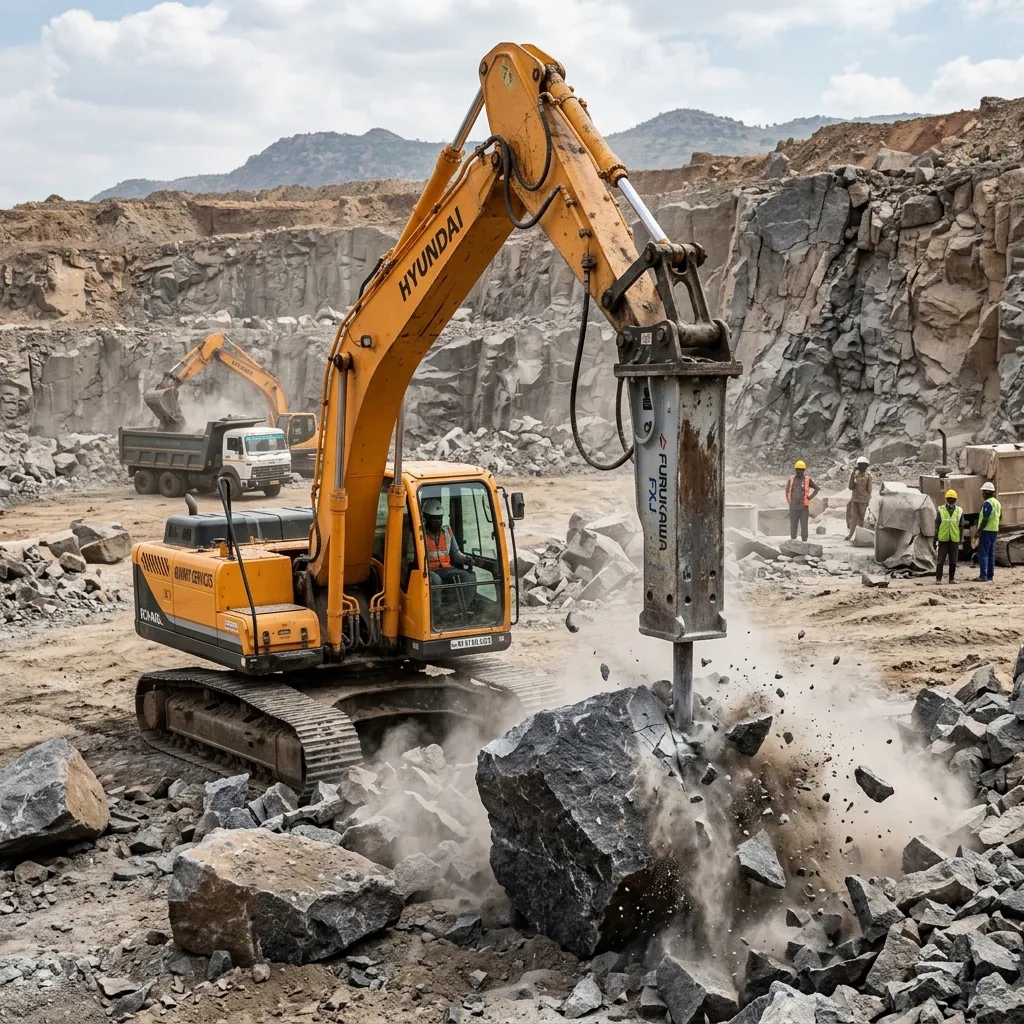
The geological makeup of the Coimbatore district is notorious for its basaltic rock formations and hard granite strata. When developing a site in areas like Madukkarai or Thudiyalur, excavation quickly transitions from simple earthmoving to a complex mechanical battle. For a Class-I contractor, succeeding in this rocky terrain requires specialized tools and strict scheduling.
1 · Crawler Excavators & Hydraulic Rock Breaking Operations
Implementing robust standards for crawler excavators & hydraulic rock breaking operations requires aligning our field crews with standardized geotechnical and engineering procedures.
The geology of Coimbatore district features extensive basaltic and hard granite formations, particularly in industrial zones like Madukkarai, Thudiyalur, and Perundurai. Blasting is strictly controlled or banned near residential areas. Instead, we rely on mechanical rock excavation. We deploy 20-ton and 30-ton crawler excavators equipped with hydraulic breaker attachments (chisels). These heavy breakers apply impact energy to split rock along joint planes. Where the rock is massive and lacks joints, we use non-explosive expanding demolition agents (chemical splitting). Holes are drilled in a grid pattern, filled with the expanding mortar, which exerts expansive stress over 24 hours to crack the rock. This process is noise-free and vibration-free, complying with local environmental regulations and protecting adjacent structures. We also utilize drum cutters for precise rock profiling along excavation edges, minimizing over-break and reducing concrete consumption. The excavated rock is sorted and crushed on-site for reuse as road subgrade or filling material, reducing haulage costs and environmental impact.
Accurate earthwork estimation is a primary driver of civil contracting profitability. During the pre-construction survey phase, we calculate excavation (cut) and embankment (fill) volumes. Ideal site development designs achieve an earthworks balance, where the volume of soil excavated matches the volume required for filling low areas and building embankments. When excavations yield poor-quality soil (like highly organic topsoil or expansive black cotton clay), it cannot be used as structural fill. We must factor in the cost of disposing of this spoil and importing graded gravel from approved borrow pits. Our estimators model these variables to ensure tender bids reflect actual transport and disposal costs. We utilize advanced earthwork calculation software to run multiple design iterations, optimizing grading profiles to minimize cut-and-fill imbalances. This analytical approach protects our project budgets and ensures we submit competitive, realistic tenders for public works projects.
"The geology of Coimbatore district features extensive basaltic and hard granite formations, particularly in industrial zones like Madukkarai, Thudiyalur, and Perundurai."
2 · Non-Explosive Expanding Demolition Agents (Chemical Splitting)
Under our Coimbatore PWD quality guidelines, executing non-explosive expanding demolition agents (chemical splitting) demands rigorous verification of all field metrics and material properties.
Meticulous topographic surveying is the first step in successful site development and grading. Our engineering teams deploy Leica Total Stations and RTK (Real-Time Kinematic) GPS receivers to map site contours with millimeter accuracy. A high-density grid of elevation points is established, referencing permanent benchmarks linked to the national height datum. This digital spatial data is imported into CAD software to generate 3D digital terrain models (DTM) and calculate earthworks balances. Balancing cut-and-fill volumes minimizes the need to import expensive fill gravel or pay for hauling surplus soil off-site. Accurate stakeouts ensure that structural foundations, drainage channels, and roadway subgrades are excavated to the precise design coordinates and slopes, eliminating manual alignment errors and ensuring smooth surface drainage. During construction, we perform regular check-surveys to verify excavation depths and structural alignments, preventing deviations before concrete is poured. This digital workflow streamlines the client approval process and provides a precise as-built record for future site maintenance and expansion.
Effective surface drainage is the single most critical factor in extending the service life of bituminous and concrete roads. Standing water penetrates asphalt, stripping the bitumen binder and creating potholes under traffic loads. We grade roadways with a precise cross-slope camber (typically 2-2.5% for asphalt roads and 1.5-2% for concrete roads) from the center crown to the shoulders. This cross-slope sheds water to concrete side drains. The longitudinal gradient must be kept above 0.3% to prevent water from pooling in side drains. Grade and slope checks are verified using electronic sensors on motor graders and checked manually using line-levels to ensure compliance with NHAI and MoRTH drainage standards. We also design and construct concrete culverts and catch basins at low points to channel runoff away from the roadway. The side drains are lined with stone masonry or precast concrete U-drains to prevent erosion of the shoulder, protecting the structural integrity of the pavement structure from water damage.
3 · Stormwater Runoff & Concrete Interceptor Drainage Designs
To achieve maximum structural stability during the stormwater runoff & concrete interceptor drainage designs phase, we enforce strict compliance controls across our regional sites.
Heavy construction machinery uptime is critical to meeting tight project timelines. Our fleet, including excavators, motor graders, soil compactors, and transit mixers, undergoes rigorous preventive maintenance. Soil and dust from excavation sites accelerate wear on track chains, pins, and rollers; we enforce daily undercarriage washdowns. Hydraulic systems are checked for pressure drops and water ingress, which can damage hydraulic pumps. Engine oil, filters, and air intake systems are serviced at designated running hour intervals (typically every 250 hours). By maintaining comprehensive service logs and stocking critical spares at our Coimbatore yard, we minimize on-site breakdowns and maintain high operational efficiency. We also train our operators to perform daily pre-start checks, monitoring coolant levels, hydraulic hoses, and warning indicators. This proactive maintenance culture ensures machinery availability and enhances site safety by preventing equipment failures during critical operations.
Managing dump truck dispatch logistics is essential for large-scale earthwork and paving projects. We operate a fleet of 10-ton and 20-ton tippers, coordinated using a central logistics platform. GPS tracking provides real-time visibility into truck positions, travel speeds, and cycle times. We analyze this data to identify bottlenecks at loading quarries or site dumping zones. By adjusting dispatch intervals and rerouting trucks around traffic, we maintain a steady flow of materials to the paving site, maximizing machinery utilization and minimizing project timelines. We also monitor fuel efficiency and driver shift compliance, using fleet diagnostics to manage operating costs. This logistical control ensures aggregate deliveries align with paving rates, maximizing highway paving efficiency.
| Quality Verification Step | Audit Standard | Tolerance Benchmark / Compliance Target |
|---|---|---|
| Material Receipt Inspections | IS 383 Sieve Analysis | Zero organic contaminations; moisture grading within curves |
| Field Density Compactions | IS 2720 Part 28 Sand replacement | Minimum 98% field dry density versus lab standards |
| Concrete Cube Compressive Checks | IS 516 Compressive strength | Target 28-day crushing load exceeded on all cast cubes |
4 · Subgrade Preparation & WMM Fissure Stabilization over Rock
A major element of managing subgrade preparation & wmm fissure stabilization over rock successfully lies in coordinating logistics, material testing, and machinery runtime.
Successful infrastructure project execution depends heavily on supplier relations and material procurement logistics. Materials like cement, reinforcing steel (TMT bars), and aggregate represent over 60% of project costs. We leverage our Class-I standing to secure bulk pricing and direct mill shipments from primary steel and cement manufacturers. To maintain continuous supply, we establish long-term contracts with regional blue metal crushers and M-sand plants. Structured payment terms, backed by corporate bank guarantees, ensure priority supply during seasonal material shortages. Material haulage is optimized using GPS-tracked dumpers to coordinate dispatch from crushers to the paving site, ensuring that asphalt pavers and concrete batching plants operate continuously without logistical delays. We also maintain on-site material stockpiles to buffer against supply disruptions, and inspect incoming material quality to ensure compliance with project specifications. This coordinated logistical approach minimizes project delays and protects our margins from material price volatility.
Executing public works in dense urban areas like Coimbatore city requires active community relations management. Road upgrades, pipeline installations, and drainage works inevitably cause traffic diversions, noise, and dust. We coordinate closely with ward counselors, local police, and resident welfare associations to publish clear traffic diversion plans. Water tankers spray dry subgrades multiple times daily to suppress dust, and high-impact operations like asphalt milling and rock breaking are limited to daytime hours. Clear warning signage and contact details for the site supervisor are posted around the site perimeter, allowing residents to raise issues directly and ensuring that public grievances are resolved before escalating to local authorities. We also recruit local community liaisons to manage public concerns, providing regular updates on project progress and traffic impacts. This proactive approach minimizes project delays, builds community goodwill, and ensures smooth execution of municipal infrastructure projects.
5 · Earthwork Cut-and-Fill Calculations & Spoil Disposal Logistics
Ultimately, our site supervisors inspect every phase of earthwork cut-and-fill calculations & spoil disposal logistics to prevent structural settling and secure client sign-off.
Maintaining comprehensive quality records is a core requirement for PWD and NHAI project compliance. Our project offices maintain registers for material receipts, concrete pours, compression test results, and level checks. Material delivery tickets, mill certificates, and third-party laboratory reports are filed systematically. These records are reviewed during inspections by departmental engineers, verifying that all materials and construction processes meet project specifications before billing approvals are granted. We also compile as-built surveys, quality logs, and contract documentation, preparing detailed project handbooks for municipal and state agencies. This rigorous drafting procedure supports our Class-I standing, ensuring quality compliance across all public works.
PWD projects are subject to strict quality control audits by departmental engineers and third-party testing agencies. Quality audits involve inspecting raw material test certificates, reviewing batch plant logs, and conducting in-situ tests. We maintain a mobile testing laboratory equipped to perform grain-size distribution, liquid limit, plastic limit, and compaction testing directly on-site. All test results are logged in a quality register signed by our QC engineer and the department representative. Maintaining this detailed quality record is a prerequisite for billing approvals, demonstrating our commitment to delivering infrastructure that meets PWD specifications. We also coordinate third-party inspections with independent testing labs, validating our field and laboratory test results. This quality assurance framework ensures that all construction works meet contractual quality standards, facilitating timely payment approvals and project sign-offs.
6 · Vibration Monitoring & Neighboring Structural Safety Controls
Furthermore, daily reporting and quality logging are mandated to maintain complete project visibility and contract compliance.
Setting out building and road alignments requires establishing a high-accuracy survey grid. We establish a local traverse network using high-precision Total Stations, referencing permanent benchmarks. We set out structural grid lines, foundation corners, and roadway centerlines, marking them with iron pins and concrete monuments. Level checks are conducted regularly using digital levels to verify excavation and concrete pouring elevations, ensuring structural alignments comply with construction tolerances. We cross-verify alignments with structural design documents, confirming spacings and dimension details before structural casting. This survey verification process prevents layout errors, ensuring all structures are constructed at their correct spatial positions and design gradients.
Enforcing safety protocols on busy construction sites requires ongoing worker training. We conduct mandatory 15-minute toolbox talks every morning for all site personnel. These talks cover specific safety topics, such as correct use of Personal Protective Equipment (PPE), trench safety, safe lifting techniques, and crane operations. Site supervisors conduct daily safety walks to identify hazards like loose electrical cables, missing handrails, or unsafe ladders. By engaging workers directly in safety discussions and enforcing a zero-tolerance policy for safety violations, we foster a proactive safety culture. We also document safety audits and report near-misses, utilizing safety logs to improve site safety rules. This worker training and safety tracking system protects our field crew, achieving a zero-accident safety record across our construction projects.
Operational Summary & Takeaways
This concludes our comprehensive analysis on site development challenges in rocky terrain. At Sri Vari Constructions, we understand that delivering high-performance infrastructure requires a combination of advanced engineering, rigorous quality assurance, and deep local geological knowledge. As a licensed Class-I Civil Contractor serving Coimbatore, Tiruppur, Erode, and the wider Kongu region, we adhere strictly to the latest Ministry of Road Transport and Highways (MoRTH) standards, Tamil Nadu Public Works Department (PWD) specifications, and NHAI quality guidelines. By maintaining a privately owned fleet of over 85 machinery units—including hydraulic excavators, motor graders, and vibratory compactors—and employing experienced site engineers, we ensure that every project we undertake is built to last. Our commitment to daily reporting, strict safety protocols, and robust engineering standards has established us as a trusted partner for public works and private industrial site developments across Tamil Nadu.